That Badass Portal ARG

So, you’ve probably heard about the glut of crazy Valve news that’s popped up in the past week: Portal 2, Steam for Mac, all that jazz. When the alternatereality game announcing Portal 2 came up, I heard about it within half an hour or so and spent the whole night camping out on the Steam forums, watching people with actual tech skills solve it while I pretended to do homework. Fantastic times. Later, when I had the chance to describe the scope of the ARG to a few of my friends, I found time to reflect on what Valve actually did with that stuff. And it was still pretty astonishing to me, even after seeing it all come out.

Change the ending to a game you released three years ago to build hype on a sequel? If they’d done it badly, people would have been pissed, but since Valve are digital wizards whose fantastic PR and mastery of our fanboy/girl brains amounts to some kind of crazy blood magic, and because they’re effin brilliant, everyone was excited about it. It’s a new kind of game marketing. How often does that happen? Some people in the Valve forums were suggesting that Valve’s hiring of super-skilled MINERVA: Metastasis creator Adam Foster, who used to like to do his releases and updates in the style of ARGs, had something to do with this. Even if they hired him just for his crazy-good map design, they would have been justified; hiring a smart-as-hell mod designer for his self-promotion techniques is a bit more than that. It’s yet another example of how much Valve know what they’re doing.

Apparently some people hate ARGs. But I am not these people, and I have never met any of them. I actually prefer it. Television advertising for games is usually a bit condescending, when you think about it: all that prerendered video, all the absurdly-brief in-game footage, clipped down to just the finishing moves and the glitter, as if they’re trying to hide something. And the enormous quantity of advertising they do on game review sites, which are ostensibly there to provide consumers with unbiased opinions, can actually be unethical.

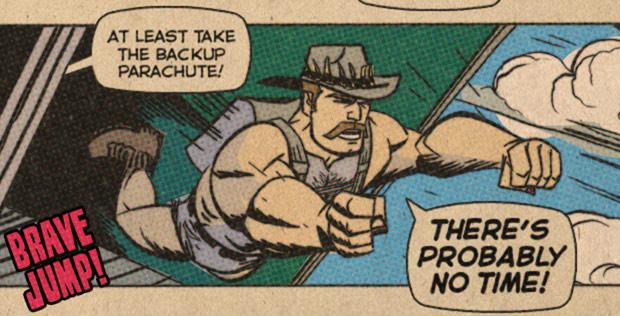
But stuff like the Portal ARG is special. It treats consumers with a certain amount of praise and consideration that traditional marketing techniques don’t: it’s an intelligence-stimulating, community-flattering kind of thing. If Valve thought we were all dumb as bricks, it would never have decided to do the release as an ARG. If Valve didn’t give a shit about its community, it wouldn’t have done an ARG. The other kinds of hilarious advertising they do, like the TF2 updates, are drenched with an exuberant irony that also grants intelligence to the consumer, but without being exclusive, or telling jokes meant to leave anyone confused. It doesn’t take much brainpower to appreciate the Saxton Hale comic, but it’s dumb in a current, conscious kind of way. AN APE WILL DIE ON EVERY PAGEThere are plenty of cultural references in there, such as the fake comic covers, for anyone who has the context to understand them. It speaks of extraordinary care on Valve’s part. But this is what we’ve come to expect from Valve, so even though we’re excited, surprised, and appreciative, we’re not as surprised as we would have been if, say, Ubisoft pulled this.
But if this kind of thing catches on elsewhere, what could happen? Will it become typical for game studios to produce, say, mid-season DLC designed to link games with their sequels? That would be cool, but it would be coolest if the DLC was free. Will more companies start putting the attention and care into their fanbases that Valve already has? I bet a lot are trying, but they don’t have Steam, so it’s harder for them. Or is this a sign that games as products could become more fluid, that auto-updates to official game plot could become a typical phenomenon? Maybe, but there’s a lot of danger in that: mishandling such a thing could be seen as an invasion of player experience, a breach of trust. Or will this inject more energy into PC gaming as a platform experience—the only platform where games and the internet lie so close together? PC games have always been particularly creative in comparison to console games, and today we’ve got an indie community with a lot of energy and innovation—a community Valve draws from. It would be nice to see more developers get excited about PC gaming again because of that innovation, but we’re always going to have to deal with the hobbling millstone of piracy, too, won’t we?

Ambiguous situations and troubling questions aside, I see the ARG as a good sign for PC gaming. People still care, guys. There are a million bajillion of us out there, and not everybody thinks we’re idiots. It’s awesome.

Machinarium’s Ending Sucks

Endings are hard to do. I have an English professor who asserted once in class that ‘most endings are bad… pretty much, all endings are terrible.’ In a way, he’s right. Story endings are artificial. They’re where we choose to stop telling a tale that, in the context of the real, continuing world, has no actual end. The editorial act of forcing an end to a story’s living world can be an easy thing to mess up: many people would put this kind of blame on Harry Potter.

A puzzle! WoooooThe best ending of any kind that I can think of is possibly the ending to Casablanca, followed quickly after by the ending to Watership Down, which actually made me cry when I was in fourth grade. I can’t think of many games that have a similar sense of profound resolution. Indigo Prophecy’s ending arguably ruined the game for me; the ending to Beyond Good and Evil is a bit too baffling to be fully satisfying. Many people detest BioShock’s ending. The ending to KOTOR II was an uninspired mess. There are games out there with spectacular finales, but I’d argue that they’re the exception to the rule: Modern Warfare is one. Portal is another.* Usually, after the player has spent his or herself on a traumatically difficult boss battle, where can a game go? Can tying up the loose ends of a possibly feather-light plot compete with the excitement of climactic play? Often, no. Games have it tougher than most media when it comes to endings.

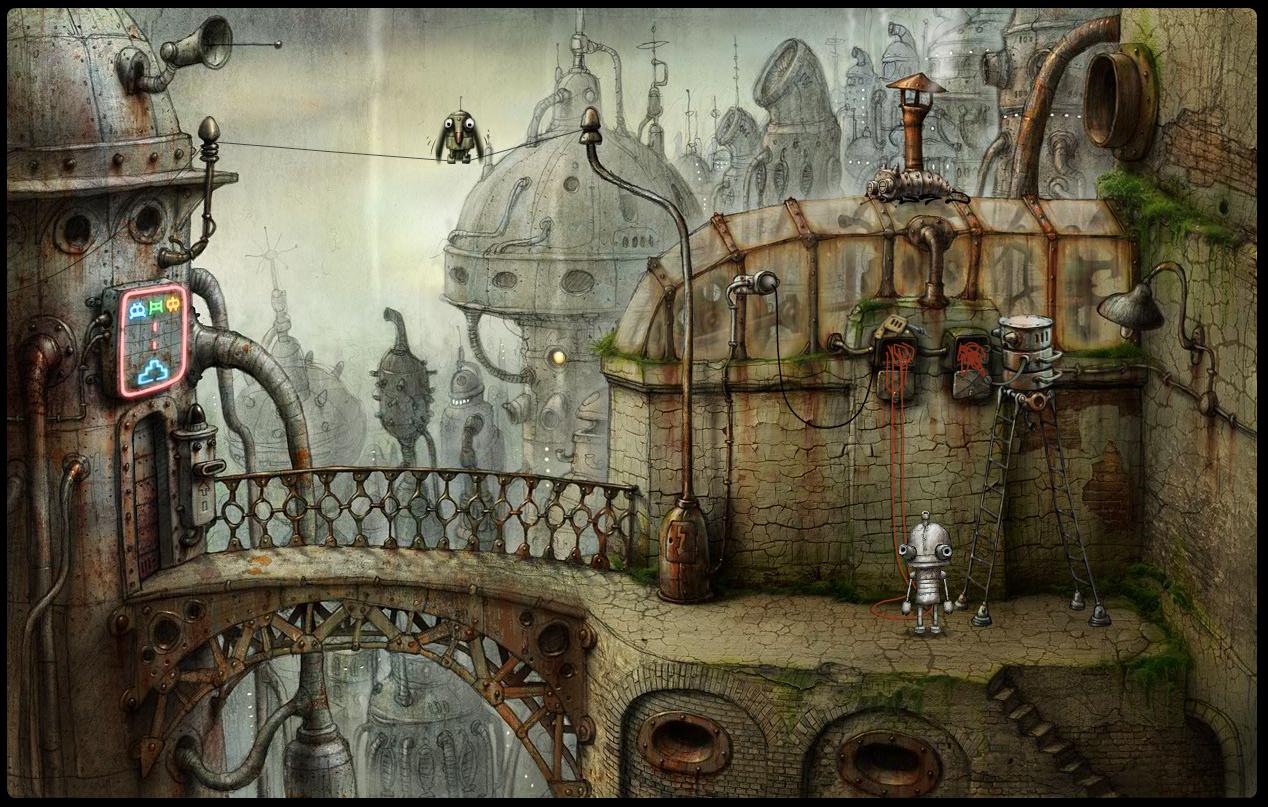
Machinarium is one of those games where you can feel the ending coming from far away. It feels very right. The action, which until the final hour or so has been spread all across a small city of robot people, begins to narrow, finally converging on a few puzzle-dense rooms stranded, lonely and hollow, high above the clouds. The music, which is frankly my favorite part of the game, becomes more resonant and contemplative, while the images become more arresting and, frankly, disturbing: the last character you meet is eerie, or at least a bit unsettling, in a way I found very compelling. (Hint: you perform crazy robot psychotherapy on it. Yeah.)

The ending also addresses a common theme that runs through the rest of the game: arcade culture. Throughout Machinarium, the player is exposed to old arcade games presented in non-traditional ways: chiefly, arcade games are presented as relics of the past, as grungy, dust-splattered, rickety, bike-powered objects, entertainments occupying a space as far as possible from the slick, bright, neon experience we normally associate with arcade games. The final encounter, or boss-fight, if you will, is also an arcade game. It’s also non-traditional: its soundtrack is jarring and unpleasant, its display elements are non-rectilinear and bereft of ‘digitalness’, and…

Well. IT HAS THE WORST CONTROLS OF ANY GAME, EVER.

The final ‘boss fight’ of Machinarium is so unpleasant that I put the game down for a whole month. Though the rest of the game is a rather calm, contemplative thing, something that can be solved easily with an old and fuzzy laptop touchpad, the final ‘puzzle’ requires a mouse and infinite patience. You must play an extremely long and badly-designed Flash game for which no rules or objectives are given. Dying pulls you out into the world again, where you must repeat a few trivial adventure-game actions in order to reenter the fight. I died countless times, mainly because my screen was wider than the game file itself (Machinarium is Flash) and every time my cursor left the game panel, I would lose control of the character and die. Furthermore, it’s a mouse-aim game with no separate controls for your avatar: you trail around after the aim cursor, able to control your own position only indirectly. I’m sure that not everyone had as huge of a problem with it as I did; nevertheless, it’s so badly designed that I doubt it would do well as stand-alone gameplay. Which is important in a game that’s partially about games. It’s not the main theme, but it’s prominent, and I expected better.

One of my favorite puzzles. It’s got the best background music.

Furthermore, I feel that it pollutes the atmosphere of the entire game: it features your robot taking down enemies with a gun. Up until this point, Machinarium is about a relatively-pacifist underdog robot who is eternally harassed by aggressive, bombastic, armed criminals. I did not expect his final triumph to involve shooting people, even digital people.

Aside from this, I enjoyed Machinarium immensely. It’s a gorgeous adventure game with awesome puzzles—something I hope to write about soon. I’m pretty sure that, art, difficulty, and puzzle-wise, it’s the best adventure game produced by anyone, ever, in several years.

But I haven’t yet played Time Gentlemen, Please, so don’t hold me to that assessment.

* Though the ending has apparently changed due to that awesome ARG— something I need to take a look at!

My Experiences as a Transsexual Lesbian in Albion

I started Fable II as a man, and now I am a woman.  Let me explain.

When you finish the main storyline and buy the castle Fairfax, you are given a short quest to clear your dungeons of bandits.  At the end of the quest you discover a potion that is in a vial shaped suspiciously like a penis.  “This potion will alter the very gender of the man or woman who drinks it,” the potion’s description informs me.  What the hell, I think, why not? I place the phallic glass between my lips and I tip my head back.  A puff of smoke and I emerge a woman.  Obviously the first thing that you do when you get a sex change is to check out the new equipment. I take off all of my clothes.  I’m still muscular and tattooed, but I have a brand new pair of breasts.

Even though I’m a woman, I still look like a man.  I’m taller than everyone on the street.  I’ve got a square jaw and burly arms.  I wonder: what will my wives think?

I have two living wives and one fiancé.  The fiancé was an accident.  She was standing next to my future wife and I proposed to the wrong woman.  As far as I can tell, there is no way to break off the engagement.  She still follows me around sometimes, nagging me about when I’m going to get her a house (you can’t get married without a house).

My first wife died in a bandit raid.  My second wife, Ellen, lives in Bowerstone and we have a little girl named Angela.  When I return home my wife greets me with “Oh, honey!  I’m so glad you’re home!”  My kid runs up to me: “Mommy! Mommy!”   It’s actually pretty eerie.  No one comments on my sex change.  The thing is, my wife is straight.  I wonder if she’ll still sleep with me.  In Fable II you have to flirt with your wife before she’ll sleep with you.  So I whip out her favorite gesture: seduce!  She laughs at me “I’m not that desperate!”  Well how about a smooth pick up line.  “Oh please.  Find someone else!”  Apparently her scripted responses are exactly the same as they would have been if we were just two strangers on the street.

My fiancé has a silver ring above her head. My wife has a gold ring above her head. The four people with hearts over their head are in love with me 'cause of my sexy hat.

My third wife is a zombie.  I brought her back from the dead and then got her to marry me, which was probably the most awesome thing I’ve ever done in Fable II.  Her name is Lady Grey.  Unlike my second wife, Lady Grey is bisexual.  How will this affect her response to my sex change?

Lady Grey and our daughter–my second child, Angela–are both ecstatic to see me.  Again no one seems to notice my new body.  I waste no time in propositioning my wife for sex.  Flex, flirt, seduce.  “You make me feel so…feminine!” says my wife.  HA!  Well, I’m on a roll.  Boom, I pop the question.  You? Me? Upstairs?  “Please,” she responds, “be gentle.”  We hit the sack for some unprotected love-making.  Just like we would have if I had been a man.

I’m glad that Fable II provides room for all sorts of different sexual identities.  It seems strange, however, that there is so little difference between the way that people treat a straight man and the way that people treat a transsexual lesbian.  This is obviously not the case in our society.  Maybe that’s okay, though.  Maybe it’s a good thing that in this fantasy world people aren’t judged by their gender or their sexual preferences.  If Fable II is imagining some ideal alternative to our own world, why shouldn’t it sweep discrimination under the rug?

Still, though, I’m convinced that my wife should have some reaction when I get a sex change.  There has been only one time that any NPC has so much as acknowledged my gender swap.  “Hey, didn’t you used to be a man?” asks a random man on the street.  And that’s it.  Otherwise, the game just treats me like a woman.  Who is somehow married to a straight woman.

Let’s count the gender differences that the game does provide: for one thing, men can’t get pregnant.  When you are a pregnant female character and you are starting to show, the game just fast-forwards nine months and then you can leave your kid with your husband.  You can’t get pregnant unless you’re married, you can’t get pregnant with lesbian sex, and you can’t miscarry.

Men can’t have sex with straight men or gay women and women can’t have sex with straight women or gay men.  Men and women look different.

hmm...

If you’re a man and you put on women’s clothes, your “silliness” will increase.  Putting on a man’s clothes as a woman has no different effect.  In fact, my now female character still runs around in male clothing, since it makes me marginally more attractive than wearing a dress would.  The main way that attractiveness is calculated in Fable II is through the clothes that you wear (weight, strength and hairstyle are minor factors).  Generally, posh and expensive clothing makes you more attractive.  Running around topless makes you less attractive, regardless of how you sexy you think you look with your shirt off.  In order to win over the affections of nearly anyone, all you have to do is put on a fancy coat and stand next to them.  There are literally hundreds of characters in love with me in Fable II.  Running through a populated area inevitably leads to an entourage of babbling admirers.

For both men and women, being muscular makes you more attractive and being fat makes you less attractive.

In our society, the “ideal woman” isn’t muscular—she’s thin and toned.  If you want to make your female character look “pretty” in the conventional western sense of the word, you would need to avoid using physical attacks in the game.  I imagine that Lionhead didn’t want the player to feel like having a female character would limit his or her experience of the game.  Thus, in Albion muscles look good on men and women, and a female body-builder would be twenty points more attractive than the digital equivalent of Penelope Cruz or Scarlett Johansson.

Again, I don’t think that there is necessarily anything wrong with this.  But maybe they could have programmed each NPC to find different things attractive.  Maybe some people don’t like muscular men, some love muscular women, and some people love a shirtless guy.  Maybe some people are turned on by ruffled shirts.  Maybe your spouse gets annoyed if you always wear the same clothing.

The more I think about it, though, the more I feel like the big problem here isn’t with Fable.  It’s with games in general.  We just aren’t at a place where we can create anything similar to the feelings that a real relationship would produce.  My wife’s stilted reaction to my sex change is bothersome, but would it really be that much better if she got upset and divorced me?  The game doesn’t attempt to convey the social repercussions of getting a sex change—but does it effectively convey the experience of any relationship?  Not really.  Maybe the real question here is why I’m looking for something like a real relationship in a video game at all.  I guess that I want to play a video game that can make me as attached to an NPC as I was to Aragorn or President Bartlett.  It hasn’t happened yet.

“Why does our society reinforce gender stereotypes?” My daughter randomly asks me.  Is she saying this because she has two mothers?  Would she have said this if I was still a man?  I have no idea.  “Never mind,” she continues, “I’ll just go and play with my dolls.”

This is why I still like Fable II despite its many flaws.  The game doesn’t take itself seriously, so why should we?  It makes me laugh.  It makes me think.  Maybe that’s enough.  You get a pass this time, Molyneux.  But I’m still pissed about the race thing.

Sleep is Death

I preordered Sleep is Death today. Which is interesting, considering I was not an enormous fan of Passage.

I hated Passage for a pretty specific, personal reason. There was actually a lot about it I did enjoy: I liked the minimalist style, and I appreciated the player’s bleak lack of control over life and death. As a game where action equals metaphor, it works perfectly. But I had a problem with the meaning of the metaphor.

There’s a brief line in this article about every day the same dream that captures my feelings about Passage: Passage is trite, simplistic, and false. It’s too-perfect love. If that’s how Jason Rohrer thinks he’s living his life, hand in hand down a long hallway of colors, together all the time, great for him. That isn’t how most people live.

His assumption that this is life is what comes across as pretentiousness: anyone who doesn’t agree with the premise of the metaphor is going to perceive him as making art out of falsehood. During the time when I first played Passage, I was pretty lonely and was generally mildly upset with the universe; the game made me want to hunt Rohrer down and kick him in the face for being so blandly happy.Yeah, my reactions to everything he makes are totally personal and subjective– but I’d like to think that’s how he wants people to react to his games. On a personal level. On that personal level, I just wanted to kick him in the face for being happy in his stupid hallway, and for assuming that his own minor navigational problems, so to speak, were profound.

But Sleep is Death doesn’t look like anything trite at all. Where Passage was about what I see as a kind of fake idealism, Sleep is Death is going to be about actual interaction, about the problematic, fast-paced negotiation of a shared gamespace. The slideshow trailer he put up shows the kind of ambiguous, troublesome play that I appreciate in my game-metaphors about life.

Also: Storybook Weaver crossed with being a Dungeon Master. BEST. GAME. CONCEPT. EVER. I grew up on Storybook Weaver!

Good job, Mr. Rohrer: here are my dollars. I promise I won’t try to write class papers about how much I hate you anymore (something I actually tried to do last summer). I have formally erased you from my official List of Dicks. Be free, Mr. Rohrer. Show the world you know what the hell you’re doing. Again.