Magazines, Games and Trees

Magazines. I have them.

One of my favorite panels at PAX East was on “The Death of Print.”  In this panel John Davidson, the Editor of the new GamePro, raised a point that has worried for me for some time.  Print media seems to be at odds with environmentalism.  The UN says that deforestation is “now widely recognized as one of the most critical environmental problems facing the human society today with serious long term economic, social and ecological consequences.”  John shared a startling statistic: if a print magazine sells 30% of the magazines that it prints, this is considered a success.  That means that 70% of magazines are simply thrown away.

Chris Dahlen, the managing editor of Kill Screen, raised the issue of the magazine as artifact.  The problem with an article on the Internet is that you can’t hold it in your hands.  You can’t put it in a box in your attic and find it twenty years later, brushing off a cloud of dust and swelling with nostalgia.

I love books.  I love the way that they smell and the way that they feel on my thumbs and my index fingers.  I love the sound of a page turning and I love lying on a couch with a book on my chest and a lamp behind me.  Flipping through Kill Screen and GamePro on the bus to Boston was a wonderful experience – the writing was uncommonly good and I didn’t have dozens of banners and tabs distracting me.  If print died a part of me would die with it.

Which is why I struggle with this so much.  Sometimes it seems like art and the environment are at odds and I have to choose a side.

The issue is bigger than just print magazines – video games themselves are by nature unsustainable.  Computers and consoles have dangerous toxins in them that are often illegally recycled overseas, posing serious health and environmental risks.  (Read this.)  Playing games consumes lots of energy, and I’ve bought dozens of games, only rarely considering the environmental implications of my purchases.  I care about the planet, but I deeply care about games as well.  I’ve been struggling to reconcile all of this.

Other mediums like movies aren’t particularly sustainable either, but movies have been vehicles for change more often than games have.  Documentaries like An Inconvenient Truth and Exporting Harm (topical – a 2002 documentary about electronic waste in China) have been able to profoundly raise public awareness about important issues.  We haven’t had our world-shaking game yet.
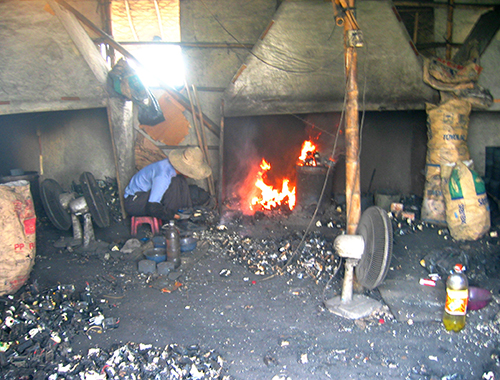
A view inside the burn houses where women sit by the fireplaces and cook imported computer parts. Guiyu, China. May 2008 ©2008 Basel Action Network (BAN)

The thing is, I think that we can.  Games are an extremely young medium, and we have a lot of room to grow.  Right now, the primary concern in game design is whether or not the player is having fun.  This isn’t the case in other art forms; many movies, paintings, photographs, novels, and plays are crafted to make the viewer uncomfortable, for instance.  Don’t get me wrong, I’m all for having fun, but why can’t we have other emotional experiences as well?  Why can’t we have a mystery game where we explore a recycling factory in China?

I appreciated John Davidson’s comment because I’m glad to be reminded that other people out there struggle with these things too.  Once a year there’s an exciting festival in New York called Games for Change – it happens in a bit over a month. Unfortunately that’s right before exams, but you should go if you can.  Here at Dartmouth, the tiltfactor lab is focused on game design for social change.  In the coming weeks I’m going to play a few games that are taking risks and pushing the boundaries of what games might be able to be and write about them here.

So those are my thoughts.  I read an article today that deforestation has been on the decline in the past decade – the rate is “remains alarming,” but it’s nice to read good news once in a while.  I have to believe that there is a way for video games and magazines to exist in a healthy world.  What do all of you think about this?
Max Payne and the Pictoralists

Kent’s post about games and their relation to old media got me thinking. It’s best to read this one if you’ve read his first.

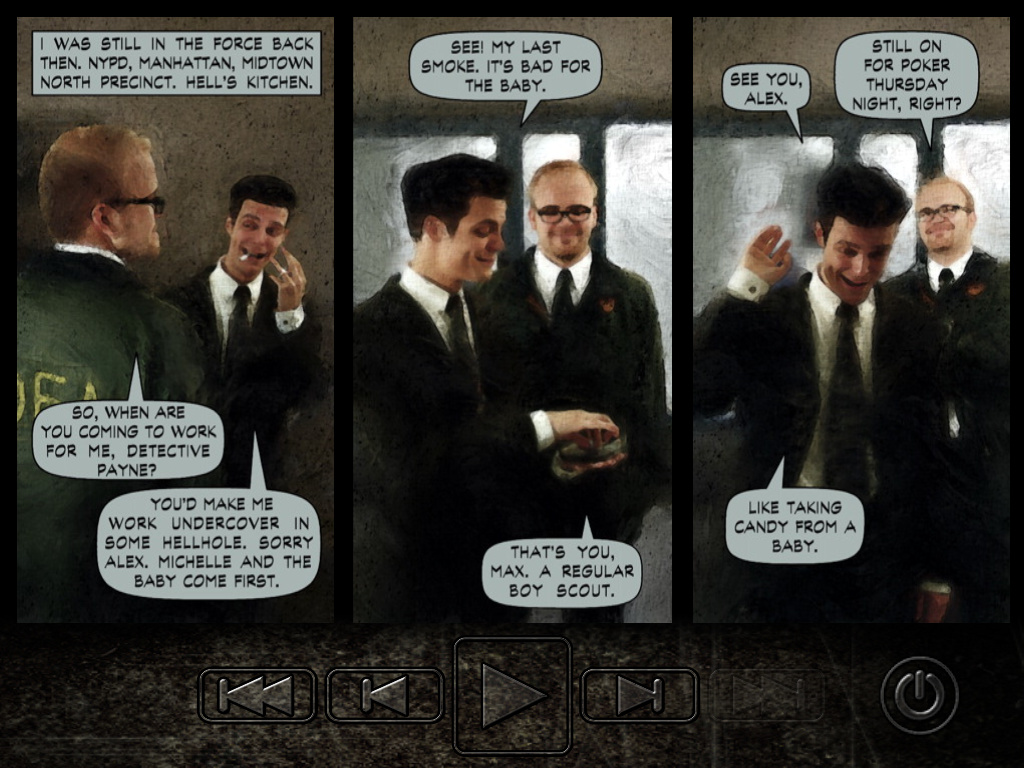
Because my 360 is at school and my computer is too shoddy to handle Bioshock 2 right now, I’m currently playing Max Payne. In case you never played Max Payne, here’s what you need to know: it is The Departed crossed with John Woo crossed with every B-movie cops-and-robbers flick you’ve ever seen. All the cutscenes are comic strips. They’re not even real comics: they’re photographs layered over with ultra-cheesy Photoshop art filters, with speech bubbles and word boxes slapped on top. The language is such a heavy kind of noirish nonsense that it gets hard to handle after a while. Constant references to the dark nature of the city, the predatory howl of sirens, the call of the night, that kind of thing. In short, the game wants so badly to be everything that crime novels, action movies, and gritty thriller comics have ever been that it’s practically bleeding out the anus to accomplish this.

Nevertheless, it’s fun as hell. The John Woo fighting moves are incorporated as bullet-time dodge-jump-and-shoot attacks—at one point, Max even remarks that he’s about to get “all Chow Yun Fat” on his enemies’ collective rear ends. It’s marvelous. The whole game crawls right up into that sweaty place under the armpit of twentieth-century pulp fiction and sits there grinning like a monkey and clapping its hands, and there’s nothing you can do but love it.

Aside from the bullet time effects, which were very unique and awesome when the game came out, there’s not much special about the stuff the player does in the game. You’ve got a million different weapons, grenades, rocket launchers, et cetera. Stupid boss fights. A couple halfhearted puzzles, because every game in the universe needs a puzzle, right? It’s the standard shooter rigmarole through and through. A few hallway laser-bomb puzzles are direct references to situations found in Half-Life. What saves it from being derivative is the style: By accessing that whole antihero-thriller- noir-cops-and-robbers heritage, Max Payne transformed itself from a poorly-balanced shooter into something completely magical.

Its aims are a bit like those of the Pictoralists, described in Kent’s post, but with a bit more punch. Max Payne adopted non-gamic inspiration in the most audacious manner possible by flaunting its relationship to movies and comics. It’s trying to be a movie and a comic, at the same time, while also being a game. The basic attacks are obvious homages to Woo’s Hard Boiled, for crying out loud! It doesn’t try to be a movie in the same way that Heavy Rain does, but it’s still trying, and it cleaves so tightly to that heritage that it inherits all the excitement and energy of the old media. It knows why we love movies and trashy books and comics, and plays up to that. We don’t keep playing Max Payne simply because the game itself is well-made; we love it because it’s a bombastic send-up of everything pulp and horrible. In spirit and attitude, it’s the ultimate action movie and the ultimate comic.

So: Demons’ Souls is fantastic, on a gamic level. But not every game has to be Demons’ Souls. And not every game should be. Games that go in the exact opposite direction are often just as marvelous.

Becoming Art

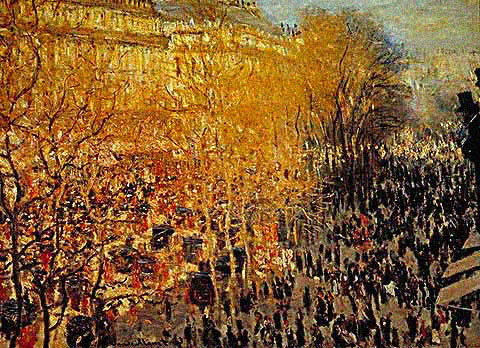
Monet, Boulevard des Capucines (1873)

In response to the popularization of the daguerreotype in the mid 1800s, Paul Delaroche famously declared: “from today, painting is dead!”  For the past few centuries, paintings had been coming closer and closer to reality, and suddenly here was a new medium—photography—that seemed to render all of those efforts pointless.  Enter Manet and the impressionists, who stopped trying to precisely mimic reality and instead tried to capture the surreal quality of light and the emotion of a landscape.  Of course, painting was far from dead.  Painters just had to discover what set them apart from other art forms, and they had to capitalize on these differences.  The work of Manet, Monet, Van Gogh or Matisse could never have been made with a camera.

Similarly, when photography was invented it struggled to be perceived as art.  Pictorialists like Demachy and Davidson tried to mimic the efforts of the impressionists in their photographs.  They used techniques like gum bichromate to blur the details of a photo to make it look more like a painting.  The Pictorialists were trying to get photography recognized as an art form by showing how it could be like a medium that already attained artistic recognition.

Ansel Adams, Half Dome, Apple Orchard, Yosemite (1933)

Along came Ansel Adams and friends, who founded Group f/64.  In their manifesto, they stated that they were “striving to define photography as an art form…through purely photographic methods.”  They defined pure photography as “possessing no qualities…derivative of any other art form.”  Instead of trying to make paintings with their cameras they explored the unique capacity of photography to create sharp and accurate images.

Still with me?  Here’s the connection to games: Mass Effect 2 is Demachy and Demon’s Souls is Ansel Adams.  We all want games to be perceived as a medium capable of creating art, but we’ve been trying to get there in different ways.

Demon’s Souls approaches narrative in the exact opposite way that Bioware does.  In Mass Effect 2, the story is told through conversations and journal logs.  The voice acting is stellar.  The writing is great.  The camera sweeps in cinematic motion and all of the visuals are coated in film grain.  Mass Effect 2 tries to hoist itself onto the pedestal of another medium (and it isn’t alone).  It is certainly a great experience, and it’s tons of fun to play, but it doesn’t embrace its identity as a game in the way that Demon’s Souls does. Demon’s Souls demonstrates the unique storytelling capacity of games better than any other game I can think of.  It plays to the strengths of its medium; it isn’t trying to be a book and it isn’t trying to be a movie.

In Demon’s Souls you discover each place’s history without any help from a datalog.  There is a constant sense of mystery as you explore the rich corridors and caverns.  You are always pressing further into the fog, unsure of what one-hit-killer is waiting just beyond your range of vision.  Your clanking armor echoes on the cave walls and you are surrounded by groans and heavy breathing.  The space around you is crowded with shuffling life, but you still feel so lonely huddled in the womb-like dark.

Crowded with shuffling life

Demon’s Souls forces you to absorb its environment.  You trudge through the same spaces over and over again and become intimately familiar with each tunnel and vista.  The game doesn’t give you a map, but after playing it I could draw one.   In a game like Oblivion or Assassin’s Creed, space is repetitive and disposable.  In Demon’s Souls no space is wasted.  The world is big and it’s filled with variety.  You will visit every corner of it.

Everyone agrees: Demon’s Souls is difficult.  This is offset by the best melee combat mechanics that I’ve ever experienced.  The blocking and dodging are intuitive.  You can hear the thwack of flesh when you chop into an enemy with a sword.  The controls are so right that mastering them is a wonderful experience.  The precise manipulation of my digital body gives me a very physical sense of the game.  Each on-screen movement is a natural extension of my thought.

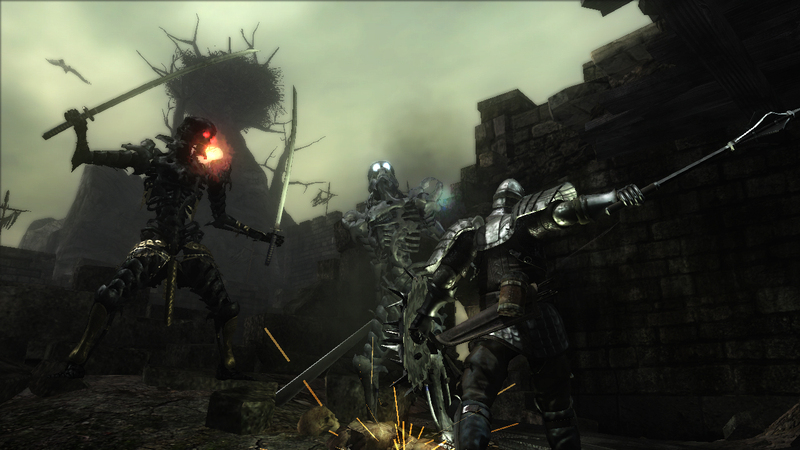
After I kill the first boss in the Boletarian Palace, I am once again in human-form, complete with shiny body and robust health bar.  I wander into the wind-whipped Shrine of Storms.  Imagine my chagrin when a dual-katana-wielding skeleton rolls over to me and dispatches me in a single hit.  “Damn you, rolling skeleton!” I shout at the screen.  I come back for more.  He kills me again.  And again.  I slowly learn the pattern of his attacks: roll, roll, slash, pause, roll, slash.  I hold my shield up to him in a challenge.  I sway and I dodge and then—BAM!—I get him from behind.  Several blows later he lies in a pile of bones at my feet.  But the next rolling skeleton has an archer friend who thwarts my masterful tactics by staggering me at just the wrong time, and I’m dead again.  Fast-forward to a few hours later when I’ve been killed a long ways into the level.  I dodge and hack my way through what used to be grueling battles with ease.  It isn’t because I have a bigger health bar or a more powerful sword.  The game has taught me how to fight, and that is why I love it.

Some rolling skeletons in the Shrine of Storms

In order to be widely recognized as a means for artistic expression, games need to explore the unique qualities of their gaminess, just like Manet did with paint and Adams did with a camera.

Demon’s Souls tells a story through the way that the player inhabits the gamespace.  The combat isn’t just a way of getting you to the next cutscene.  This is what ‘gamic’ means.  You don’t have to learn excruciatingly difficult fighting techniques in order to read a book or watch a movie.  I’m thirty hours in and Demon’s Souls has told me an amazing and visceral story in a way that a movie or book could not have done.  Surely this is art.

—-

This certainly won’t be the last thing I write about Demon’s Souls.  I haven’t even mentioned the unique multiplayer component of the game, and there are so many more stories to tell.  I’m also planning on putting my fancy HD PVR to use and recording some nice videos for you to watch!

In the meantime, why not check out my two favorite articles on Demon’s Souls, by Michael Abbott on GameSetWatch and Tom Bissell on Crispy Gamer.

That Badass Portal ARG

So, you’ve probably heard about the glut of crazy Valve news that’s popped up in the past week: Portal 2, Steam for Mac, all that jazz. When the alternatereality game announcing Portal 2 came up, I heard about it within half an hour or so and spent the whole night camping out on the Steam forums, watching people with actual tech skills solve it while I pretended to do homework. Fantastic times. Later, when I had the chance to describe the scope of the ARG to a few of my friends, I found time to reflect on what Valve actually did with that stuff. And it was still pretty astonishing to me, even after seeing it all come out.

Change the ending to a game you released three years ago to build hype on a sequel? If they’d done it badly, people would have been pissed, but since Valve are digital wizards whose fantastic PR and mastery of our fanboy/girl brains amounts to some kind of crazy blood magic, and because they’re effin brilliant, everyone was excited about it. It’s a new kind of game marketing. How often does that happen? Some people in the Valve forums were suggesting that Valve’s hiring of super-skilled MINERVA: Metastasis creator Adam Foster, who used to like to do his releases and updates in the style of ARGs, had something to do with this. Even if they hired him just for his crazy-good map design, they would have been justified; hiring a smart-as-hell mod designer for his self-promotion techniques is a bit more than that. It’s yet another example of how much Valve know what they’re doing.

Apparently some people hate ARGs. But I am not these people, and I have never met any of them. I actually prefer it. Television advertising for games is usually a bit condescending, when you think about it: all that prerendered video, all the absurdly-brief in-game footage, clipped down to just the finishing moves and the glitter, as if they’re trying to hide something. And the enormous quantity of advertising they do on game review sites, which are ostensibly there to provide consumers with unbiased opinions, can actually be unethical.

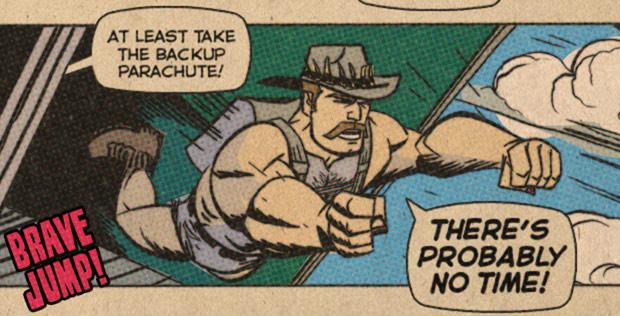
But stuff like the Portal ARG is special. It treats consumers with a certain amount of praise and consideration that traditional marketing techniques don’t: it’s an intelligence-stimulating, community-flattering kind of thing. If Valve thought we were all dumb as bricks, it would never have decided to do the release as an ARG. If Valve didn’t give a shit about its community, it wouldn’t have done an ARG. The other kinds of hilarious advertising they do, like the TF2 updates, are drenched with an exuberant irony that also grants intelligence to the consumer, but without being exclusive, or telling jokes meant to leave anyone confused. It doesn’t take much brainpower to appreciate the Saxton Hale comic, but it’s dumb in a current, conscious kind of way. AN APE WILL DIE ON EVERY PAGEThere are plenty of cultural references in there, such as the fake comic covers, for anyone who has the context to understand them. It speaks of extraordinary care on Valve’s part. But this is what we’ve come to expect from Valve, so even though we’re excited, surprised, and appreciative, we’re not as surprised as we would have been if, say, Ubisoft pulled this.

But if this kind of thing catches on elsewhere, what could happen? Will it become typical for game studios to produce, say, mid-season DLC designed to link games with their sequels? That would be cool, but it would be coolest if the DLC was free. Will more companies start putting the attention and care into their fanbases that Valve already has? I bet a lot are trying, but they don’t have Steam, so it’s harder for them. Or is this a sign that games as products could become more fluid, that auto-updates to official game plot could become a typical phenomenon? Maybe, but there’s a lot of danger in that: mishandling such a thing could be seen as an invasion of player experience, a breach of trust. Or will this inject more energy into PC gaming as a platform experience—the only platform where games and the internet lie so close together? PC games have always been particularly creative in comparison to console games, and today we’ve got an indie community with a lot of energy and innovation—a community Valve draws from. It would be nice to see more developers get excited about PC gaming again because of that innovation, but we’re always going to have to deal with the hobbling millstone of piracy, too, won’t we?

Ambiguous situations and troubling questions aside, I see the ARG as a good sign for PC gaming. People still care, guys. There are a million bajillion of us out there, and not everybody thinks we’re idiots. It’s awesome.

My Experiences as a Transsexual Lesbian in Albion

I started Fable II as a man, and now I am a woman.  Let me explain.

When you finish the main storyline and buy the castle Fairfax, you are given a short quest to clear your dungeons of bandits.  At the end of the quest you discover a potion that is in a vial shaped suspiciously like a penis.  “This potion will alter the very gender of the man or woman who drinks it,” the potion’s description informs me.  What the hell, I think, why not? I place the phallic glass between my lips and I tip my head back.  A puff of smoke and I emerge a woman.  Obviously the first thing that you do when you get a sex change is to check out the new equipment. I take off all of my clothes.  I’m still muscular and tattooed, but I have a brand new pair of breasts.

Even though I’m a woman, I still look like a man.  I’m taller than everyone on the street.  I’ve got a square jaw and burly arms.  I wonder: what will my wives think?

I have two living wives and one fiancé.  The fiancé was an accident.  She was standing next to my future wife and I proposed to the wrong woman.  As far as I can tell, there is no way to break off the engagement.  She still follows me around sometimes, nagging me about when I’m going to get her a house (you can’t get married without a house).

My first wife died in a bandit raid.  My second wife, Ellen, lives in Bowerstone and we have a little girl named Angela.  When I return home my wife greets me with “Oh, honey!  I’m so glad you’re home!”  My kid runs up to me: “Mommy! Mommy!”   It’s actually pretty eerie.  No one comments on my sex change.  The thing is, my wife is straight.  I wonder if she’ll still sleep with me.  In Fable II you have to flirt with your wife before she’ll sleep with you.  So I whip out her favorite gesture: seduce!  She laughs at me “I’m not that desperate!”  Well how about a smooth pick up line.  “Oh please.  Find someone else!”  Apparently her scripted responses are exactly the same as they would have been if we were just two strangers on the street.

My fiancé has a silver ring above her head. My wife has a gold ring above her head. The four people with hearts over their head are in love with me 'cause of my sexy hat.

My third wife is a zombie.  I brought her back from the dead and then got her to marry me, which was probably the most awesome thing I’ve ever done in Fable II.  Her name is Lady Grey.  Unlike my second wife, Lady Grey is bisexual.  How will this affect her response to my sex change?

Lady Grey and our daughter–my second child, Angela–are both ecstatic to see me.  Again no one seems to notice my new body.  I waste no time in propositioning my wife for sex.  Flex, flirt, seduce.  “You make me feel so…feminine!” says my wife.  HA!  Well, I’m on a roll.  Boom, I pop the question.  You? Me? Upstairs?  “Please,” she responds, “be gentle.”  We hit the sack for some unprotected love-making.  Just like we would have if I had been a man.

I’m glad that Fable II provides room for all sorts of different sexual identities.  It seems strange, however, that there is so little difference between the way that people treat a straight man and the way that people treat a transsexual lesbian.  This is obviously not the case in our society.  Maybe that’s okay, though.  Maybe it’s a good thing that in this fantasy world people aren’t judged by their gender or their sexual preferences.  If Fable II is imagining some ideal alternative to our own world, why shouldn’t it sweep discrimination under the rug?

Still, though, I’m convinced that my wife should have some reaction when I get a sex change.  There has been only one time that any NPC has so much as acknowledged my gender swap.  “Hey, didn’t you used to be a man?” asks a random man on the street.  And that’s it.  Otherwise, the game just treats me like a woman.  Who is somehow married to a straight woman.

Let’s count the gender differences that the game does provide: for one thing, men can’t get pregnant.  When you are a pregnant female character and you are starting to show, the game just fast-forwards nine months and then you can leave your kid with your husband.  You can’t get pregnant unless you’re married, you can’t get pregnant with lesbian sex, and you can’t miscarry.

Men can’t have sex with straight men or gay women and women can’t have sex with straight women or gay men.  Men and women look different.

hmm...

If you’re a man and you put on women’s clothes, your “silliness” will increase.  Putting on a man’s clothes as a woman has no different effect.  In fact, my now female character still runs around in male clothing, since it makes me marginally more attractive than wearing a dress would.  The main way that attractiveness is calculated in Fable II is through the clothes that you wear (weight, strength and hairstyle are minor factors).  Generally, posh and expensive clothing makes you more attractive.  Running around topless makes you less attractive, regardless of how you sexy you think you look with your shirt off.  In order to win over the affections of nearly anyone, all you have to do is put on a fancy coat and stand next to them.  There are literally hundreds of characters in love with me in Fable II.  Running through a populated area inevitably leads to an entourage of babbling admirers.

For both men and women, being muscular makes you more attractive and being fat makes you less attractive.

In our society, the “ideal woman” isn’t muscular—she’s thin and toned.  If you want to make your female character look “pretty” in the conventional western sense of the word, you would need to avoid using physical attacks in the game.  I imagine that Lionhead didn’t want the player to feel like having a female character would limit his or her experience of the game.  Thus, in Albion muscles look good on men and women, and a female body-builder would be twenty points more attractive than the digital equivalent of Penelope Cruz or Scarlett Johansson.

Again, I don’t think that there is necessarily anything wrong with this.  But maybe they could have programmed each NPC to find different things attractive.  Maybe some people don’t like muscular men, some love muscular women, and some people love a shirtless guy.  Maybe some people are turned on by ruffled shirts.  Maybe your spouse gets annoyed if you always wear the same clothing.

The more I think about it, though, the more I feel like the big problem here isn’t with Fable.  It’s with games in general.  We just aren’t at a place where we can create anything similar to the feelings that a real relationship would produce.  My wife’s stilted reaction to my sex change is bothersome, but would it really be that much better if she got upset and divorced me?  The game doesn’t attempt to convey the social repercussions of getting a sex change—but does it effectively convey the experience of any relationship?  Not really.  Maybe the real question here is why I’m looking for something like a real relationship in a video game at all.  I guess that I want to play a video game that can make me as attached to an NPC as I was to Aragorn or President Bartlett.  It hasn’t happened yet.

“Why does our society reinforce gender stereotypes?” My daughter randomly asks me.  Is she saying this because she has two mothers?  Would she have said this if I was still a man?  I have no idea.  “Never mind,” she continues, “I’ll just go and play with my dolls.”

This is why I still like Fable II despite its many flaws.  The game doesn’t take itself seriously, so why should we?  It makes me laugh.  It makes me think.  Maybe that’s enough.  You get a pass this time, Molyneux.  But I’m still pissed about the race thing.

Legible Bodies in Fable II

So I’m running through Bowerstone market having just rescued some slaves from captivity, and I’m feeling pretty awesome and heroic.  A villager yells at me as I pass him: “Hey! Where are you going fatty?”  I stop running and I turn around, shocked.  Did the game just call me fat? Later I’m alone in my house and I unequip all of my clothes.  I examine my character’s body, positioning the camera so that I can get a good look at myself.  Wow, I really have put on some weight, I think.  Must have been all of those pies.

In the smash-hit action RPG Fable II, eating pies or drinking beer will make you gain weight at an alarming rate.  A quick Google search yields a glut of articles that are startlingly reminiscent of those ubiquitous acai berry ads: “Lose Weight Fast in Fable 2 with these three easy steps!”

In almost all video games, the body that you begin with is the body that you end with.  This is not so in Fable II.  Since your digital body is constantly in flux, you are often reminded of the presence of your real, physical body.  While I was playing Fable II I came to identify with my avatar’s body to a greater degree than I would with most games, and this was because I was continually aware of my onscreen and offscreen bodies.  I had a moment where I felt like the “hey fatty” comment was directed at me the player.  It was jarring and uncomfortable.

Even more problematic than the way weight is handled, however, is the character morphing system.

Evil Neutral; skin color is actually related to corruption/purity more than good/evil

For those who aren’t familiar with the game, character morphing is Lionhead’s alternative to a character creation mechanic.  When the game begins, you are only given one choice: male or female.  You are given a generic body.  As the game progresses, though, your character‘s appearance changes based on his or her alignment.  Alignment is based on your actions and rated on two scales: good versus evil and corrupt versus pure.  An evil, corrupt character will have brown skin, bright red scars, prominent horns and green eyes.  A good, pure character will have a light complexion, glowing teeth, blue eyes, blonde hair and a halo.  These are the two extremes.  Combining different levels of corruption and morality can produce many interesting results.  Additionally, as you choose a path for skill development, other physical changes occur.  If you decide to focus on melee attacks and improve your strength, your character becomes more burly and mannish.  Improving your shooting accuracy increases your height, and learning magic causes your character to become covered with glowing blue tattoos.

Good Pure.

What I find most disturbing in all of this is that morality in Fable II is legibly written in the shape and color of the digital body.  Actions and appearance are made synonymous. An evil character looks evil and a good character looks good.    If you appear sinister, it’s because you’ve done terrible things like sacrifice people at the Temple of Shadows.  If you appear pure it’s because you’ve been rescuing slaves and charging your tenants fair prices.  In this game, therefore, judging someone based on their looks is no different from judging them on their actions.

If you are good and pure, you will develop handsome Aryan features.  Brown skin is associated with corruption and demonism.  Light skin is associated with purity. Correct me if I’m wrong, but isn’t this racism?

Evil Corrupt.

In my mind, not only is this game racist, it provides a tacit justification for racism.  I don’t think that the designers of this game intended to make it racist.  This is another iteration of a much older and deeper cultural prejudice—a Western tradition in which angels are white and evil has black skin.   In The Lion King, the evil lion Scar has much darker fur than all of the good lions.  It’s the same sort of thing.

There is no divide between body and self in the Fable II hero; what you look like is who you are.  By equating body and self, Fable II brings the player’s conception of her body to the front of her mind.  It invites you to wonder: what does your body say about your actions and morality?  What character traits are readable in the human form?

Next post: my life as a transsexual lesbian in Albion