Torchlight is like a job you don’t get paid for

Attention universe! I have completed the primary Torchlight campaign! Why did it take me three months of halfhearted, intermittent play? I will tell you. It is because there is no point to Torchlight.

See, unless clicking on colorful enemies is what you enjoy most in life, there’s almost no reason to ‘finish’ playing the game. Because Torchlight has an Endless Dungeon mode, finishing the primary plot only enables more and more of the same-old same-old: you get to go further down, and you get to click on baddies and receive loot. Nothing new there. There’s also no emotional or narrative reward to finishing the plot itself. Quite a lot has been said about the skeletal nature of the game’s plot, about how tepid, uncommitted, and unclear it is.  Not only does it provide no resolution—the dungeon continues—but it makes no sense. The final boss-fight is a tedious and largely-unfair low-framerate ass-raping in which the game’s evil mastermind—a badly-explained, overpowered something called ‘Ordrak’—spams mobs at you for twenty minutes. When you’re done you get a shit-ton of worthless loot.

So why did I keep at it? Frankly, I’m a sucker for numbers that go up. Preferably, numbers that go up very high, and very quickly. It’s why I bothered finishing Infectionator: World Dominator, even though I broke the game, balance-wise, while still in Africa. In Torchlight, the numbers never stop going up. It is impossible to play for an hour without leveling up twice. You are presented with improved gear so frequently that it is hard to keep track of how fast those numbers are rising. There’s not too much need for strategic assessment: each weapon has a tooltip detailing its DPS and bonuses and providing a side-by-side comparison with your current loadout. You simply look at the numbers and choose whatever has the bigger ones. At times, this kind of constant reward feels very sinister, as if the game is trying to keep you sated with numerals while it simultaneously performs a subliminal and evil reconstruction of your brain. You stagger away from the computer, a lizardlike numbness reigning in your mind, and all night long digits scroll before your eyes while the clink of gold rattles in your ears. This is Torchlight. It’s addictive like a Facebook game, but with all the garish stupidity of that genre replaced by Diablo nostalgia. It is a powerful and scientific designer drug.

But the habit is relatively easy to break. Like I said, it quickly becomes clear that there’s no higher reward to playing the game. No dramatic conclusion, no ultimate weapon, no satisfying plot twist. Just more and more of the same. This was apparently the aim of the design team, and by gum, they seem to have accomplished it. If ‘the same’ isn’t enough for you, I can’t see why you’d bother finishing the game, unless it’s for street-cred-related reasons. Instead of dragging me onward, it only left me exhausted.

This raises questions for me, though: do I play games because I want a continuing experience, or because I want a story or a progression that eventually comes to an end, the way a book or a movie does? For me, I’ve discovered that it’s the latter. I don’t want to play the same thing for ever and ever; it’s only human that our tales come to ends. If a game doesn’t want to tell me a serious story, fine, but it’s at least got to resolve itself somehow, because that, too, is human. Currently, my conception of a ‘good game’—and I understand that, with social games, casual games, DLC and so on, this isn’t the way the industry is heading—is something with a beginning, a middle, and a proper, conclusive end. A death. A max level. A final challenge that unlocks extras, maybe. Anything but an infinite perpetuation of identical play experiences. I don’t need to be able to win it—I just need to be able to feel a sense of closure, or to have a chance to find my own kind of closure. Me, personally. Any thoughts on this, guys?

Here’s a secret about me and Torchlight: I almost didn’t quit. Apparently, there’s a secret level filled with horses for characters in the 40s level range, based on the cow level in Diablo II. I consider this idea incredibly attractive. But you have to grind the incredibly dull fishing minigame to get there, so I’ve decided that I won’t be bothering.
Max Payne and the Pictoralists

Kent’s post about games and their relation to old media got me thinking. It’s best to read this one if you’ve read his first.

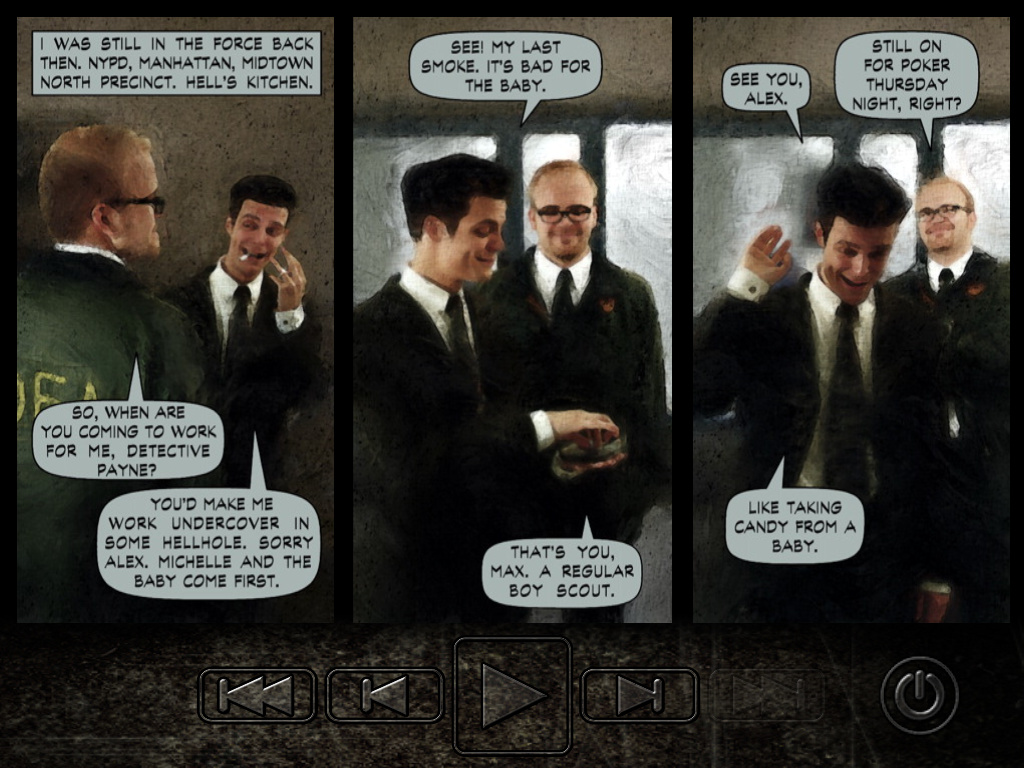
Because my 360 is at school and my computer is too shoddy to handle Bioshock 2 right now, I’m currently playing Max Payne. In case you never played Max Payne, here’s what you need to know: it is The Departed crossed with John Woo crossed with every B-movie cops-and-robbers flick you’ve ever seen. All the cutscenes are comic strips. They’re not even real comics: they’re photographs layered over with ultra-cheesy Photoshop art filters, with speech bubbles and word boxes slapped on top. The language is such a heavy kind of noirish nonsense that it gets hard to handle after a while. Constant references to the dark nature of the city, the predatory howl of sirens, the call of the night, that kind of thing. In short, the game wants so badly to be everything that crime novels, action movies, and gritty thriller comics have ever been that it’s practically bleeding out the anus to accomplish this.

Nevertheless, it’s fun as hell. The John Woo fighting moves are incorporated as bullet-time dodge-jump-and-shoot attacks—at one point, Max even remarks that he’s about to get “all Chow Yun Fat” on his enemies’ collective rear ends. It’s marvelous. The whole game crawls right up into that sweaty place under the armpit of twentieth-century pulp fiction and sits there grinning like a monkey and clapping its hands, and there’s nothing you can do but love it.

Aside from the bullet time effects, which were very unique and awesome when the game came out, there’s not much special about the stuff the player does in the game. You’ve got a million different weapons, grenades, rocket launchers, et cetera. Stupid boss fights. A couple halfhearted puzzles, because every game in the universe needs a puzzle, right? It’s the standard shooter rigmarole through and through. A few hallway laser-bomb puzzles are direct references to situations found in Half-Life. What saves it from being derivative is the style: By accessing that whole antihero-thriller- noir-cops-and-robbers heritage, Max Payne transformed itself from a poorly-balanced shooter into something completely magical.

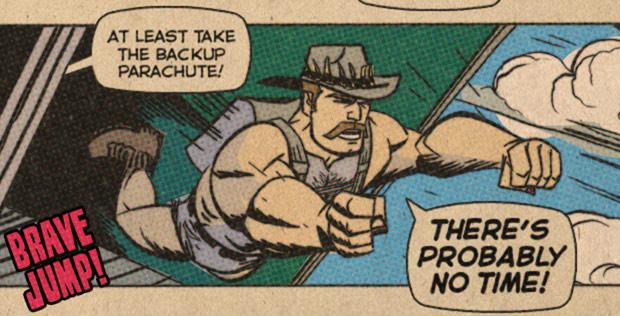
Its aims are a bit like those of the Pictoralists, described in Kent’s post, but with a bit more punch. Max Payne adopted non-gamic inspiration in the most audacious manner possible by flaunting its relationship to movies and comics. It’s trying to be a movie and a comic, at the same time, while also being a game. The basic attacks are obvious homages to Woo’s Hard Boiled, for crying out loud! It doesn’t try to be a movie in the same way that Heavy Rain does, but it’s still trying, and it cleaves so tightly to that heritage that it inherits all the excitement and energy of the old media. It knows why we love movies and trashy books and comics, and plays up to that. We don’t keep playing Max Payne simply because the game itself is well-made; we love it because it’s a bombastic send-up of everything pulp and horrible. In spirit and attitude, it’s the ultimate action movie and the ultimate comic.

So: Demons’ Souls is fantastic, on a gamic level. But not every game has to be Demons’ Souls. And not every game should be. Games that go in the exact opposite direction are often just as marvelous.

Aw man, guys: Laura got published

Wow! I wrote something and the guys at Resolution Magazine, a British-based  game reviews site I read, put it up on their site! It’s an article about how horrible it is to miss out on really important, genre-changing games because we were too busy playing something else that sucked.

Come to think of it, most of the game sites I enjoy, like Rock Paper Shotgun, and Eurogamer, and Resolution, are British. There’s something their journalists have that ours don’t. It’s a candor, or something; an ease with personal expression, with talking about games in an engaging, human way that assumes the audience is also human and intelligent. Hmmm. Something to think about.

CAGE MATCH: PART TWO: Indigo Retrospective*

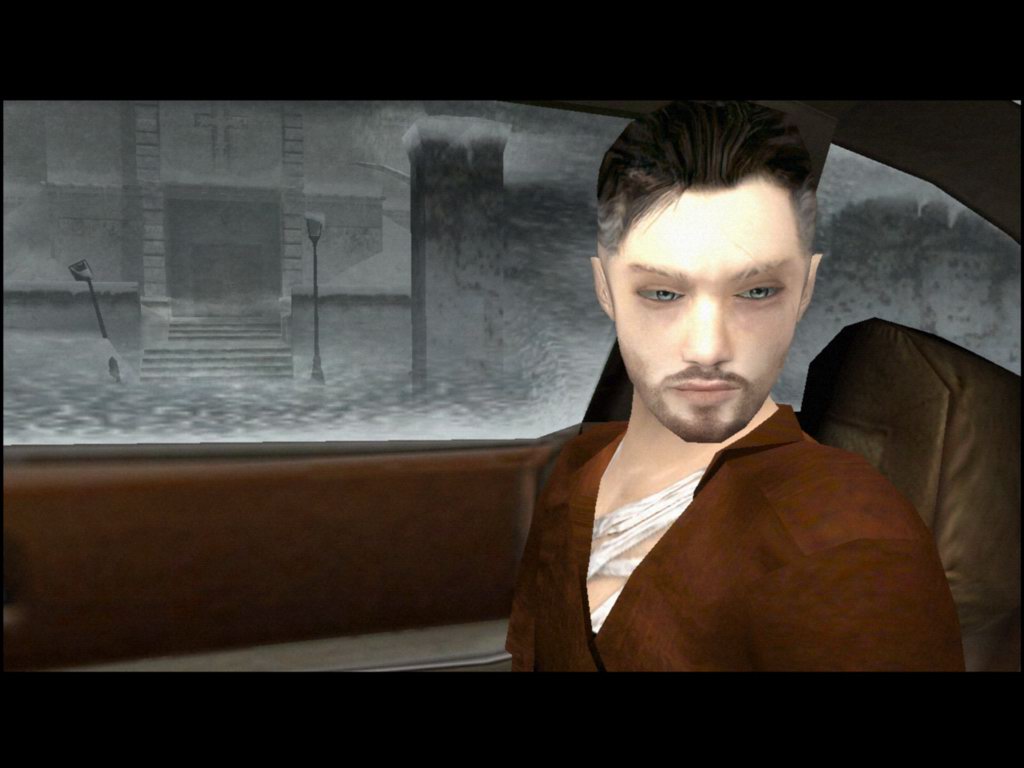
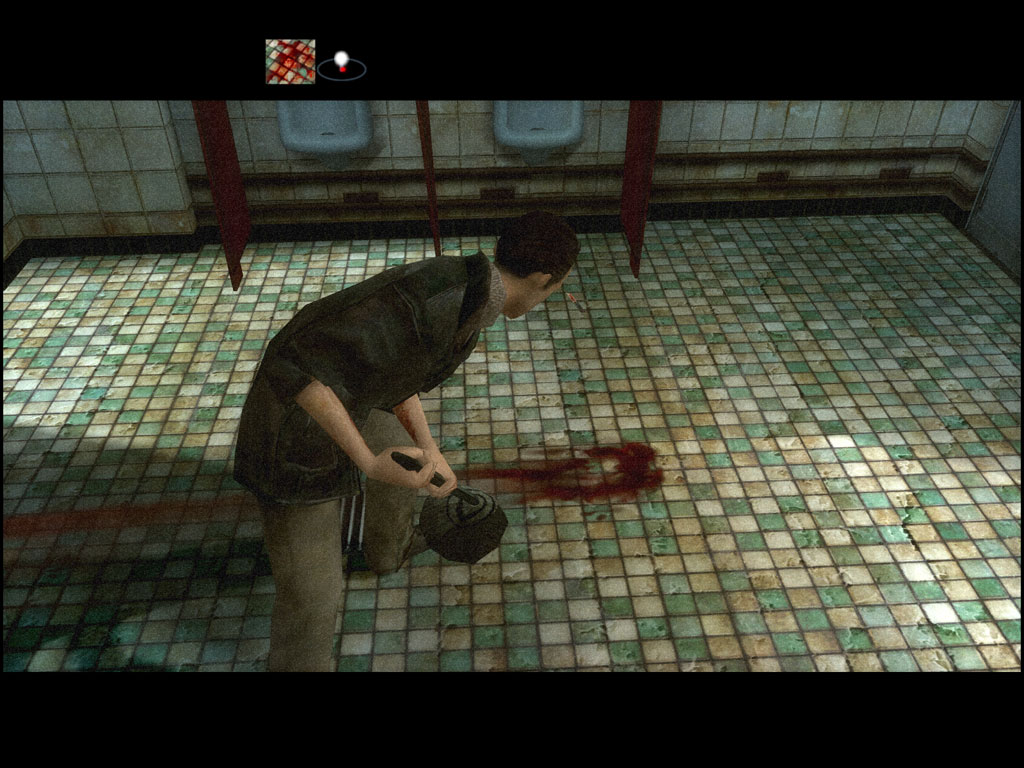
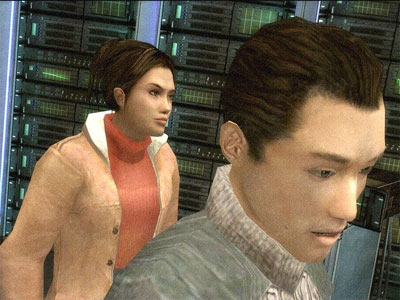
I haven’t played Heavy Rain, as I don’t own a PS3, but I have played the hell out of Indigo Prophecy, David Cage’s prior attempt at the interactive-story genre. When I picked it up, I’d just returned from an exhausting term abroad, and I wanted to sit back and enjoy a reactive game, something without statistics or strategy—basically, anything that wasn’t Dragon Age. So: Indigo Prophecy. I finished it in under two days. Then, like Jane Goodall emerging from the sweaty depths of the forest, I reemerged into society, slightly the worse for wear. Like Jane Goodall, I’d made important discoveries about the animal kingdom. Namely, I had discovered that David Cage is an absurd beast with a humorlessly bad taste in pulp fiction.

This isn’t to say that I didn’t enjoy Indigo Prophecy. I thought it was an absolute riot. But the story was awful, and the controls were absurd, and I never knew exactly what was going on or what I was supposed to be doing, which was also pretty unpleasant. But I enjoyed it the way I enjoy bad community theater: it was comfortable, not too taxing, and charming in an embarassing kind of way. Whenever I see bad community theater, I want to leap up onstage and protect all those terrible little actors from the criticism of the outside world, and I felt the same way about Prophecy. I didn’t want to compliment David Cage myself, but I wanted him to receive comments, abstractly, from somewhere: I wanted him to feel good about himself, even though he’d made a pretty questionable game.

What makes it so terrible? The controls are, in fact, awful. The disconnect between what you are doing with your hands (infamously, of course, playing Simon Says) and what your characters are doing on the screen is occasionally so unreasonable that it bears no excuse. So much has been written about this. I find it unnecessary to add anything.

According to Me, reader of this many books, the plot is also horrifically bad. I can’t justify turning this into an outright spoilerfest, but those who haven’t played it should know that they may understand only around 60% of the plot. It is a mélange of unrelated science fiction and horror tropes, cobbled together in the least convincing way. The final hour of the game consists of a showdown between, basically, two opposing tropes: teams of secret soldiers who represent different science fiction clichés actually fight and kill each other with guns. I found this hilariously symbolic. Furthermore, that final hour develops jarringly: a very filmic ‘cliffhanger’ signals a kind of act-switch, and most of the player choice that took place in the beginning is rendered meaningless afterwards. The tropes move in and take over, the illusion of agency dissolves, and the player is left wondering how the hell the plot got where it seems to have arrived. Game suffers to story here in a big way, yeah, but story suffers too, in that it’s a bad story.

But: independence? Uniqueness? Yes. The game has it.

I played Prophecy off a 10-day Dragon Age high, and I was sick of the kind of choice-making that characterizes DA. The choices in Bioware games are simply too present. Will making this decision cut me off from awesome content? Will I lose a chance at a cool party member? There’s so much content and so much choice in these games that the player can actually reign with a crazy tyranny over the plot, doing whatever he or she pleases to see whatever content he or she wants. Mass Effect, with its stupid achievements for playing through with different party members, actually encourages this kind of illusion-breaking manipulation. Now, I know that you don’t have to play a Bioware game this way, but the temptation for me is overwhelming. I want my party members. I want my absurd dialog options. If they’re there, I’m going to game the system until I get them.

Prophecy eschews this kind of analytical, manipulative play. Stuff happens, fast. You don’t have time to think about it. In order to enjoy this game, you have to give in to the writers and just let their silly story play itself out.  And when you do that, it’s fun! Nonsense occurs, and you react! You punch those fucking buttons! Snap at your boss? Yes, please! Today we’re angry! Comfort your brother? Totally. No time to think. No matter what you impulsively choose to say, characterization stays pretty solid throughout, and even when the player makes discordant decisions—decisions along the lines of the much-maligned Heavy Rain sex scene—those crazy lines are delivered with conviction by the darling cardboard cast. It’s diverting, in the Jane Austen sense of the word. It doesn’t need to be anything more. It’s the weirdest thing ever, and it’s got a confidence and a ballsy drive to be unique that more than makes up for the fact that its foundational element—its story—is a load of steaming bullcrap.

I hope Cage wasn’t too set on changing lives when he made Prophecy. It doesn’t. I think people are nervous about Heavy Rain because Cage wants it to change your life, to change the way you perceive games in general. And it seems to be actually working as a challenge to the industry, a cannon-shot over the bows, so to speak. Prophecy was more like a challenge fired out of a potato-gun. But if Heavy Rain were about nonsense science fiction instead of serial child-killers, if its emotional plot was mostly-shallow twenty-something romance instead of nervous broken-dad misery, people wouldn’t feel so challenged. David Cage figured out that battling giant green Aztec beetles was less than emotionally-compelling, so he refocused: when he says that he’s working along the same tradition as the rest of his previous work, he’s wrong. There’s something pathetic and nonthreatening about Prophecy, but Heavy Rain’s been doing a whole lot of threatening. I’m pretty sure Cage figured out that the best way to hit people emotionally was to drop the canned sci-fi chatter and go for situations that were (marginally) more-relatable.

*AW YEAH. I just typed that.

Galcon Fusion is good times, some of the time

The gulf between multiplayer and singleplayer Galcon is like the gulf between an adorable puppy and a dead puppy that is already rotting.

Actually, that’s very unfair. But there is a huge divide. In my opinion, this iPhone-game-turned-PC-clickyfest is practically only worth playing on multiplayer. Multiplayer, particularly the team multiplayer, is a strategy-rich experience; the singleplayer is a dull, brief, staccato process that seems particularly ill-suited to the PC. I’ve heard good things about it on the iPhone, but when you’re playing thirty-second strategy games in your hand, while, as one reviewer put it, brushing your teeth, that’s a very different experience from hunching in front of your computer while the whole screen fills with robot strategy triangles. It’s simply not interesting enough to deserve all that space in front of your face.

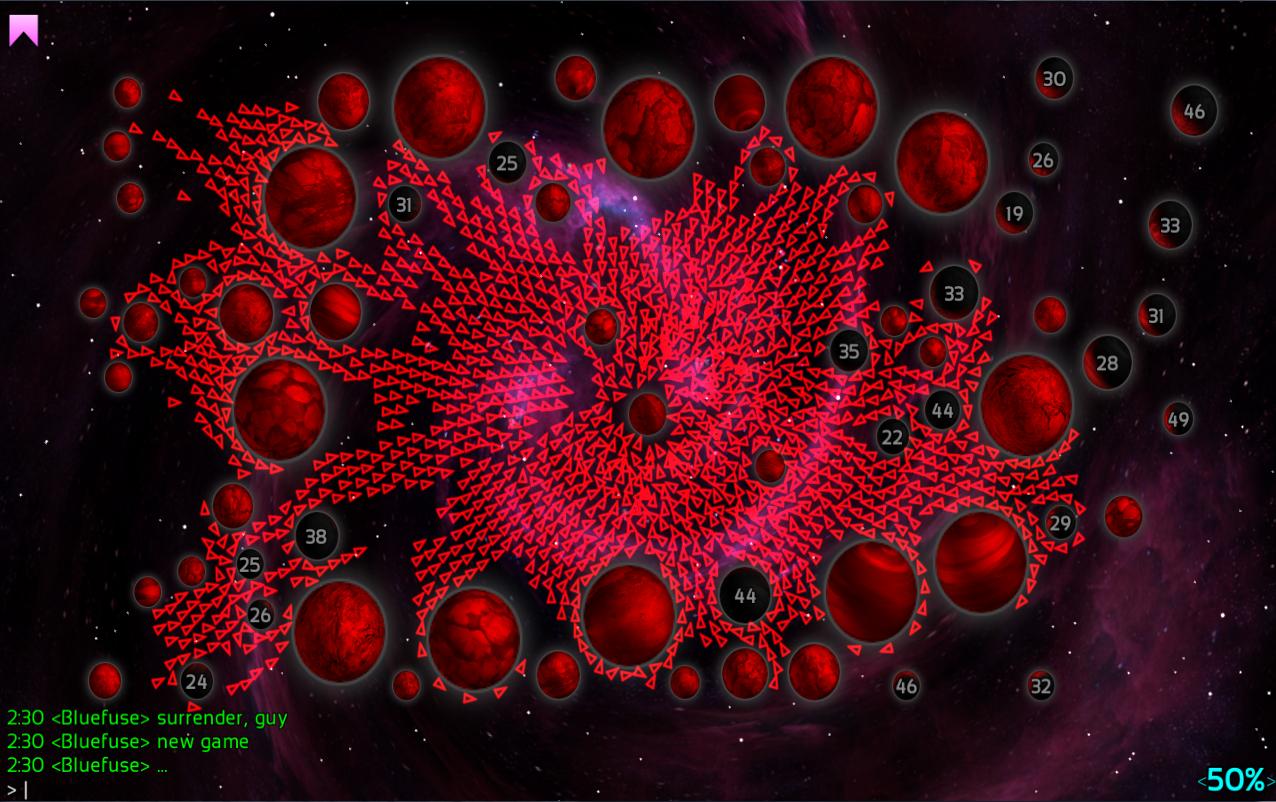
Somebody got owned. By triangles.

Because that’s what this game is all about: circles and triangles. Lean, lean visuals. Admirable depth evolving out of a very slight, pared-down set of mechanics. And the developers tried to give this PC version some more totally unneeded complexity by including a seething mess of ill-explained singleplayer game modes that seem to have no reason for existing. And then there’s the AI. It comes in ten levels, some or most of which I could not actually tell apart from one another while playing. So, make of that what you will. This is a game which deserved more than to be weighted down with a million irrelevancies.

This is mainly because the multiplayer is so fantastic. I played multiplayer once last week—during finals week at my college—for over three hours straight. And it did not feel like a waste of time.

See, Galcon multiplayer is is more explicitly a kind of communication than it is in any other strategy game I’ve tried, simply because it’s so stripped down. The units are triangles; they point where they’re going. More triangles means more troops. No triangles means a player’s turtling. Everything that happens is right there on the table, ready for players to draw their own conclusions from. The pull and play of triangles is like a conversation between opponents.

The result is an incredible range of strategy—incredible, really, for a game with only one kind of troop, one kind of command, and automated unit production. By manipulating your troop output, you can trick enemies into thinking you have more or less troops than you actually do; by changing your troops’ direction mid-flight,y ou can pull off some impressive feints. And because your enemies here are people, not AI, the kind of strategy and trickery you can pull off is so much broader, so much more satisfying. There are such a diversity of viable strategies that by the time you’ve grasped the basic mechanics you’ve probably developed a distinctly personal play-style. And these styles stick out. The game is so slight in visuals that player behavior takes the absolute center stage. Other players in your game will know you by your favorite tricks. And you’ll know them by theirs. And team multiplayer is even more glorious—those games are all about wordless cooperation, about games turning on a dime, about perpetrating a fantastic kind of human chaos. It’s something that simply isn’t possible in the singleplayer.

So, the game has terrible music, unimpressive graphics, and a singleplayer mode that struck me as a waste of time. But it has a multiplayer that, out of a few bare-bones elements, inspires a pretty-much endless strategy experience. This is some really tight design. I am incredibly impressed with it. What I’m not impressed with, though, is the fact that the multiplayer servers go absolutely cold during much of the day, which makes it impossible for me to enjoy the one aspect of the game that I actually adore.

Actually, this is what the game looks like most of the time. A bit more placid, I'd say.

I got the game for two bucks as part of an indie bundle; knowing what I know now about the singleplayer and the multiplayer server situation, I’m not sure I would have bought the full ten dollar game just by itself. At any rate, there’s a free demo on Steam. I’d certainly recommend that, but since I bought the game already I don’t even know if that demo has multiplayer in it. I hope it does—this game certainly wants to show potential customers the best it has to offer, not the worst.

Wondered where we were all last week? We were doing finals. It was kind of a bitch. But we’re back now, and you’ll be seeing some interesting stuff soon!

Also, we are going to PAX East. More about that later.

ALSO ALSO, Galcon, regular iPhone Galcon, won the Innovation in Mobile Game Design award at the IGF last year. Here’s the dev’s– Phil Hassey’s–website.

That Badass Portal ARG

So, you’ve probably heard about the glut of crazy Valve news that’s popped up in the past week: Portal 2, Steam for Mac, all that jazz. When the alternatereality game announcing Portal 2 came up, I heard about it within half an hour or so and spent the whole night camping out on the Steam forums, watching people with actual tech skills solve it while I pretended to do homework. Fantastic times. Later, when I had the chance to describe the scope of the ARG to a few of my friends, I found time to reflect on what Valve actually did with that stuff. And it was still pretty astonishing to me, even after seeing it all come out.

Change the ending to a game you released three years ago to build hype on a sequel? If they’d done it badly, people would have been pissed, but since Valve are digital wizards whose fantastic PR and mastery of our fanboy/girl brains amounts to some kind of crazy blood magic, and because they’re effin brilliant, everyone was excited about it. It’s a new kind of game marketing. How often does that happen? Some people in the Valve forums were suggesting that Valve’s hiring of super-skilled MINERVA: Metastasis creator Adam Foster, who used to like to do his releases and updates in the style of ARGs, had something to do with this. Even if they hired him just for his crazy-good map design, they would have been justified; hiring a smart-as-hell mod designer for his self-promotion techniques is a bit more than that. It’s yet another example of how much Valve know what they’re doing.

Apparently some people hate ARGs. But I am not these people, and I have never met any of them. I actually prefer it. Television advertising for games is usually a bit condescending, when you think about it: all that prerendered video, all the absurdly-brief in-game footage, clipped down to just the finishing moves and the glitter, as if they’re trying to hide something. And the enormous quantity of advertising they do on game review sites, which are ostensibly there to provide consumers with unbiased opinions, can actually be unethical.

But stuff like the Portal ARG is special. It treats consumers with a certain amount of praise and consideration that traditional marketing techniques don’t: it’s an intelligence-stimulating, community-flattering kind of thing. If Valve thought we were all dumb as bricks, it would never have decided to do the release as an ARG. If Valve didn’t give a shit about its community, it wouldn’t have done an ARG. The other kinds of hilarious advertising they do, like the TF2 updates, are drenched with an exuberant irony that also grants intelligence to the consumer, but without being exclusive, or telling jokes meant to leave anyone confused. It doesn’t take much brainpower to appreciate the Saxton Hale comic, but it’s dumb in a current, conscious kind of way. AN APE WILL DIE ON EVERY PAGEThere are plenty of cultural references in there, such as the fake comic covers, for anyone who has the context to understand them. It speaks of extraordinary care on Valve’s part. But this is what we’ve come to expect from Valve, so even though we’re excited, surprised, and appreciative, we’re not as surprised as we would have been if, say, Ubisoft pulled this.

But if this kind of thing catches on elsewhere, what could happen? Will it become typical for game studios to produce, say, mid-season DLC designed to link games with their sequels? That would be cool, but it would be coolest if the DLC was free. Will more companies start putting the attention and care into their fanbases that Valve already has? I bet a lot are trying, but they don’t have Steam, so it’s harder for them. Or is this a sign that games as products could become more fluid, that auto-updates to official game plot could become a typical phenomenon? Maybe, but there’s a lot of danger in that: mishandling such a thing could be seen as an invasion of player experience, a breach of trust. Or will this inject more energy into PC gaming as a platform experience—the only platform where games and the internet lie so close together? PC games have always been particularly creative in comparison to console games, and today we’ve got an indie community with a lot of energy and innovation—a community Valve draws from. It would be nice to see more developers get excited about PC gaming again because of that innovation, but we’re always going to have to deal with the hobbling millstone of piracy, too, won’t we?

Ambiguous situations and troubling questions aside, I see the ARG as a good sign for PC gaming. People still care, guys. There are a million bajillion of us out there, and not everybody thinks we’re idiots. It’s awesome.

Machinarium’s Ending Sucks

Endings are hard to do. I have an English professor who asserted once in class that ‘most endings are bad… pretty much, all endings are terrible.’ In a way, he’s right. Story endings are artificial. They’re where we choose to stop telling a tale that, in the context of the real, continuing world, has no actual end. The editorial act of forcing an end to a story’s living world can be an easy thing to mess up: many people would put this kind of blame on Harry Potter.

A puzzle! WoooooThe best ending of any kind that I can think of is possibly the ending to Casablanca, followed quickly after by the ending to Watership Down, which actually made me cry when I was in fourth grade. I can’t think of many games that have a similar sense of profound resolution. Indigo Prophecy’s ending arguably ruined the game for me; the ending to Beyond Good and Evil is a bit too baffling to be fully satisfying. Many people detest BioShock’s ending. The ending to KOTOR II was an uninspired mess. There are games out there with spectacular finales, but I’d argue that they’re the exception to the rule: Modern Warfare is one. Portal is another.* Usually, after the player has spent his or herself on a traumatically difficult boss battle, where can a game go? Can tying up the loose ends of a possibly feather-light plot compete with the excitement of climactic play? Often, no. Games have it tougher than most media when it comes to endings.

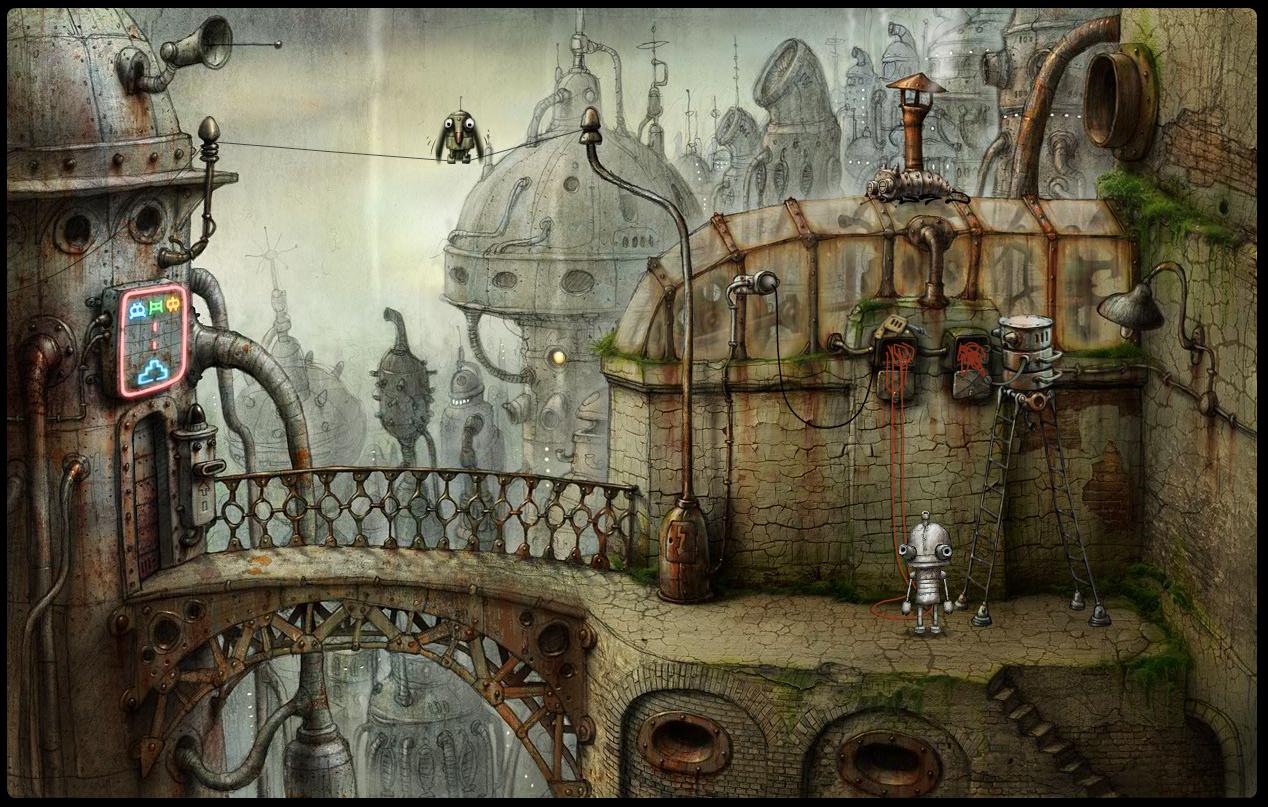
Machinarium is one of those games where you can feel the ending coming from far away. It feels very right. The action, which until the final hour or so has been spread all across a small city of robot people, begins to narrow, finally converging on a few puzzle-dense rooms stranded, lonely and hollow, high above the clouds. The music, which is frankly my favorite part of the game, becomes more resonant and contemplative, while the images become more arresting and, frankly, disturbing: the last character you meet is eerie, or at least a bit unsettling, in a way I found very compelling. (Hint: you perform crazy robot psychotherapy on it. Yeah.)

The ending also addresses a common theme that runs through the rest of the game: arcade culture. Throughout Machinarium, the player is exposed to old arcade games presented in non-traditional ways: chiefly, arcade games are presented as relics of the past, as grungy, dust-splattered, rickety, bike-powered objects, entertainments occupying a space as far as possible from the slick, bright, neon experience we normally associate with arcade games. The final encounter, or boss-fight, if you will, is also an arcade game. It’s also non-traditional: its soundtrack is jarring and unpleasant, its display elements are non-rectilinear and bereft of ‘digitalness’, and…

Well. IT HAS THE WORST CONTROLS OF ANY GAME, EVER.

The final ‘boss fight’ of Machinarium is so unpleasant that I put the game down for a whole month. Though the rest of the game is a rather calm, contemplative thing, something that can be solved easily with an old and fuzzy laptop touchpad, the final ‘puzzle’ requires a mouse and infinite patience. You must play an extremely long and badly-designed Flash game for which no rules or objectives are given. Dying pulls you out into the world again, where you must repeat a few trivial adventure-game actions in order to reenter the fight. I died countless times, mainly because my screen was wider than the game file itself (Machinarium is Flash) and every time my cursor left the game panel, I would lose control of the character and die. Furthermore, it’s a mouse-aim game with no separate controls for your avatar: you trail around after the aim cursor, able to control your own position only indirectly. I’m sure that not everyone had as huge of a problem with it as I did; nevertheless, it’s so badly designed that I doubt it would do well as stand-alone gameplay. Which is important in a game that’s partially about games. It’s not the main theme, but it’s prominent, and I expected better.

One of my favorite puzzles. It’s got the best background music.

Furthermore, I feel that it pollutes the atmosphere of the entire game: it features your robot taking down enemies with a gun. Up until this point, Machinarium is about a relatively-pacifist underdog robot who is eternally harassed by aggressive, bombastic, armed criminals. I did not expect his final triumph to involve shooting people, even digital people.

Aside from this, I enjoyed Machinarium immensely. It’s a gorgeous adventure game with awesome puzzles—something I hope to write about soon. I’m pretty sure that, art, difficulty, and puzzle-wise, it’s the best adventure game produced by anyone, ever, in several years.

But I haven’t yet played Time Gentlemen, Please, so don’t hold me to that assessment.

* Though the ending has apparently changed due to that awesome ARG— something I need to take a look at!

Sleep is Death

I preordered Sleep is Death today. Which is interesting, considering I was not an enormous fan of Passage.

I hated Passage for a pretty specific, personal reason. There was actually a lot about it I did enjoy: I liked the minimalist style, and I appreciated the player’s bleak lack of control over life and death. As a game where action equals metaphor, it works perfectly. But I had a problem with the meaning of the metaphor.

There’s a brief line in this article about every day the same dream that captures my feelings about Passage: Passage is trite, simplistic, and false. It’s too-perfect love. If that’s how Jason Rohrer thinks he’s living his life, hand in hand down a long hallway of colors, together all the time, great for him. That isn’t how most people live.

His assumption that this is life is what comes across as pretentiousness: anyone who doesn’t agree with the premise of the metaphor is going to perceive him as making art out of falsehood. During the time when I first played Passage, I was pretty lonely and was generally mildly upset with the universe; the game made me want to hunt Rohrer down and kick him in the face for being so blandly happy.Yeah, my reactions to everything he makes are totally personal and subjective– but I’d like to think that’s how he wants people to react to his games. On a personal level. On that personal level, I just wanted to kick him in the face for being happy in his stupid hallway, and for assuming that his own minor navigational problems, so to speak, were profound.

But Sleep is Death doesn’t look like anything trite at all. Where Passage was about what I see as a kind of fake idealism, Sleep is Death is going to be about actual interaction, about the problematic, fast-paced negotiation of a shared gamespace. The slideshow trailer he put up shows the kind of ambiguous, troublesome play that I appreciate in my game-metaphors about life.

Also: Storybook Weaver crossed with being a Dungeon Master. BEST. GAME. CONCEPT. EVER. I grew up on Storybook Weaver!

Good job, Mr. Rohrer: here are my dollars. I promise I won’t try to write class papers about how much I hate you anymore (something I actually tried to do last summer). I have formally erased you from my official List of Dicks. Be free, Mr. Rohrer. Show the world you know what the hell you’re doing. Again.

Hammerfight is like Omar Sharif

ATTENTION. I AM MANLY OMAR.

Or the game Omar Sharif would play. Let’s talk about it.

Like Sharif, Hammerfight is outrageously manly. Derek Yu wrote about the game’s manliness, and it was his assessment of the game—“like Charleton Heston in the Ten Commandments,” he said—that convinced me I had to own it. But I’ve come to disagree with his choice of actors. Yeah, Charleton Heston is plenty manly, but the game’s unusual style points me toward a different super-manly actor with a different cultural background and filmography.

See, Hammerfight is a game about dueling steampunk helicopter gladiators. Its setting draws equally from Dune, Ben Hur, Lawrence of Arabia, and the blisteringly insane imagination of its developers, who are a pack of clever Russians. Like Omar Sharif, a man of Franco-Libyan heritage who could play both Doctor Zhivago and Sherif Ali, the game seems to straddle an East-West stylistic divide. Out of this tension it creates a kind of weird, syncretic perfection never before seen on the face of planet Earth. Look at the man. Look at the game.

I AM ALSO MANLY. BUT A GAME.

Honestly, this game is such a hodgepodge of cultural signs that it actually escapes them and becomes own thing entirely. We’ve got the middle-eastern soundtrack. We’ve got sabers and geometric patterns and other Arabic visual cues. We’ve got the quasi-Arabic character names. We’ve got the Dune references. But on the other hand, we’ve got player advancement linked up to  ultra-western World-War-One-esque army medals and some rather Teutonic player title awards, as well as flying sandworms, steampunk, Greek architecture and Roman coins, and the absurd inclusion of retro pixel-fonts on every screen in the game. Also animated smileys: If you fly in a taunting waggle while fighting, your helicopter will flash the other helicopters an animated yellow smiley face. What.

Basically, what I’m saying is that this universe that Kranx Productions invented for its helicopter brawler is fantastic. This game is the square-jawed mythic hero-figure justice lovechild of Gamal Nasser and the Queen of England. So, Omar Sharif.

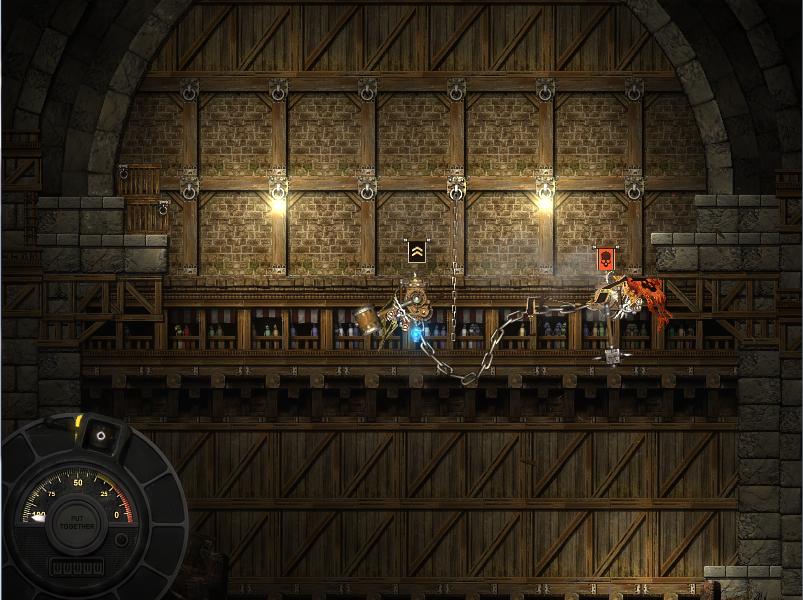
CHAIN CAGE MATCH

But what about the crazy mouse-swirling combat? Well, it’s basically genius. There is not a thing like it elsewhere in the universe. But there is a drawback: playing this game too much will give you severe tendonitis in your wrist. If you can suffer that well enough, though, you’re golden.

Like World Of Goo, this game stands upon the strength of its appealing physics engine, and play consists of teasing this engine out, elaborating upon its possibilities and feeling out its limits. Moving your mouse in circles, you struggle with centrifugal force for the control of the giant hammer hanging beneath your helicopter. You then smash things with this hammer. Or you can hang a sword there, and slice your enemies instead! Or an axe! Or you can put a wooden mallet there and play a ball sport! Fighting an enemy in the slave pits? Cool. Fighting an enemy in the slave pits while the two of you are linked by a giant chain that responds realistically to momentum? COOLER. Sick of hammers? How about swinging around some guns, learning to adjust to their solid, punchy recoil? Every possible variation on the engine’s original scenario is here. World of Goo and Hammerfight share that kind of genius.

Much of your time outside these fights is spent tricking around with different loadouts, searching for the best combination of weapons. These weapons feel meaty and significant in combat, and learning each type’s playstyle is one of the central focuses of the game. Unfortunately, there is no Hammerfight wiki, but if there were, it would probably consist mainly of pages about different kinds of weapons. Someone had better get on that.

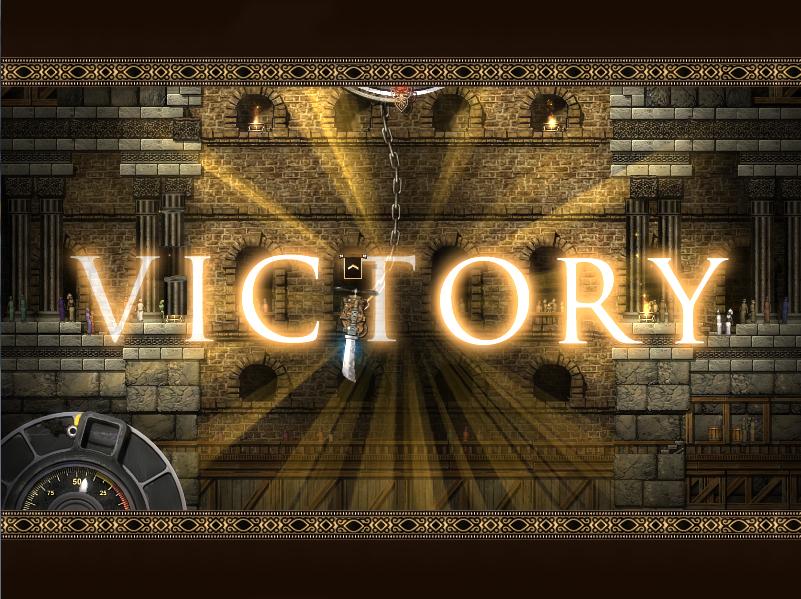
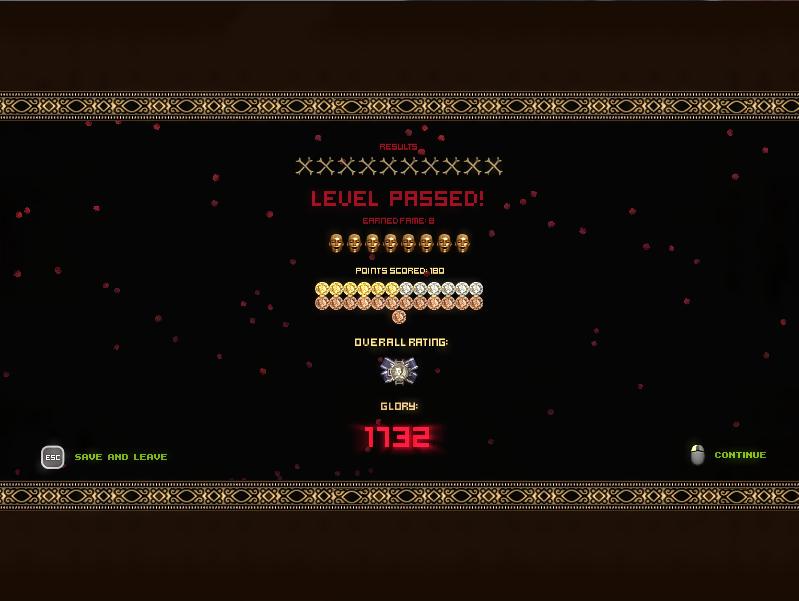
'Glory' is a statistic in this game. Awesome.

In all likelihood, though, no one will ever get on that. Very few people play this game, probably because it is outrageously difficult. The learning curve for mouse-enabled hammer-battle is quite steep, and although there is ostensibly a tutorial progression, the initial levels are pretty frustrating. In fact, the fifth level features you standing up alone to an army of giant flying-sandworm-zeppelins and a neverending stream of hovering buzzsaw robots who attack you in pairs and triples while the zeppelins fire heatseeking missiles at you. You will probably die eight or ten times, and, restarting, you will sit through the slow pre-level plotty bit eight or ten times, too. If you think you can handle it, stay on board. The real game has barely begun, and things get easier with practice.

If I ever get a time machine, I am going to do a few things with it. One of the first things I will do will be to go back to the sixties with a laptop and give Omar Sharif, then in his multicultural movieacting prime and with all his youthful hand-eye coordination still intact, the chance to play Hammerfight. Then I will come back to the present and give you all an update on what he thought about it.

If he doesn’t get tendonitis, I bet he loves it.

—-

By the way, here is a hilariously-grammared trailer from the developers, reminding you what this game is all about (‘HIGH ART OF FIGHT‘).

Learning Dwarf Fortress

For my first few posts, I’d like to write a few short articles about the mega-indie city-sim Dwarf Fortress. My gaming interests lie particularly in indie PC games, and I feel that Dwarf Fortress exemplifies the kind of raw, unleavened creativity that can make indie PC games particularly special. But DF, as it’s called, also exemplifies a lot of the qualities that make some indie games inaccessible. I’d like to talk about this tension. It’s a productive one.

—-

My first game of Dwarf Fortress lasted a good forty hours.

It went like this: I stumbled through the terrifyingly complex world-generation process, ran the Fortress Mode game, and embarked with a randomized initial party of dwarves. I had a vague idea about the game’s object: found and intensively micromanage an outrageously detailed underground ASCII city filled with dwarves. But the menus—the controls! The visual language of this game is so abstract and opaque that it’s practically Martian.

Dwarf Fortress. Scary as fuck.

What is going ON here?

I managed to survive for about eight minutes before discovering that half my dwarves had been killed by fire imps while I was busy mistaking my camel for a carpenter. In fifteen minutes I was sitting back at the main menu screen, fuming, listening to the solitary audio track loop endlessly and thinking this is a fundamentally flawed gaming experience.

Then I went online.

I read a good three hours of wiki. I studied up on two different tutorial series, video and written. I made myself more comfortable with the pause button. Then I went back to the game.

This was now hour six or seven. I generated another world, fixed my keymapping, sorted out my starting dwarf party, and embarked. I told my dwarves to dig, to chop down trees, and to build doors and beds. Then winter came. The river froze solid, and my dwarves, apparently too stupid to melt ice, got thirsty. One died, dehydrated. The others went insane. The announcement bar at the bottom of the screen explained that, in their despair, they were throwing tantrums. Two of them killed themselves, or were killed by their tantruming friends—I couldn’t tell which. The leftover ones went mad, ripped off all their clothes, and died of thirst. My fortress was destroyed.

My fortress dies.

In DF lingo, this is known as a 'tantrum spiral'.

I went back online. I read about the importance of digging wells before the winter hits.

I started again. The next trip-up was farms. I went back to the wiki. I went to the forums. I learned that this game has a tighter, more-entrenched community language than many MMOs do, and a body of foundational folkhistory comparable in breadth to that of a minor US state. I saw what others have done with this crazy machine: I became intimate with the game’s systems, and with the possibilities those systems create. I felt out the slope of the learning curve. I peeled back the idiotic user interface, the absurd ASCII graphics, the nonsensical input-output scheme that drives the game’s guts. I played the game every moment of my free time. I started six or seven different fortresses in different locations. I read an entire sixty-page forum thread about endgame scenarios I’m unlikely to ever play myself. I was in it up to my neck.

See, Dwarf Fortress is a kind of crazy quicksand. Or maybe it’s like the military. It sucks you up and breaks you down and spits you out. Let’s metaphor nerdier: I spent my thousand years in the sarlaac of Dwarf Fortress and emerged stronger, if a bit corroded.

I started up a new fortress. It was my last fortress.

I didn’t win it. It’s not a game with win conditions. Instead, I played it just long enough that I could sit back and say to myself, Laura, you know how to play this game—then I stopped playing it. That was a week and a half ago, and I haven’t played a moment of it since. I consider that the end of my first game. A good forty hours, over maybe three weeks.

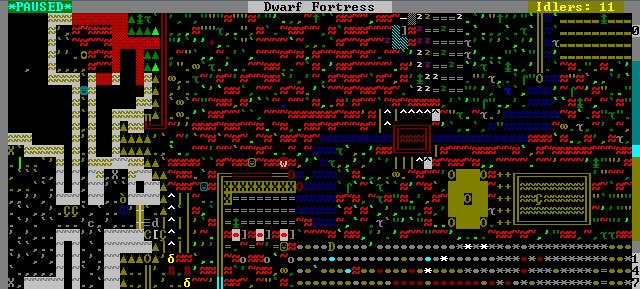
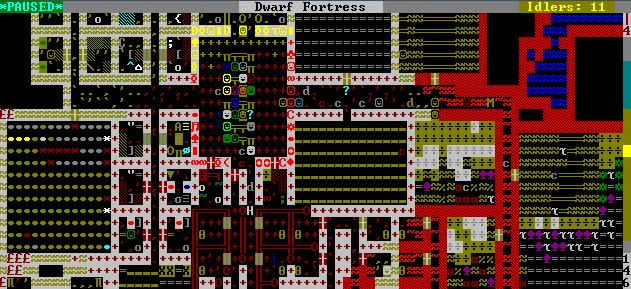
My longest-running fortress.

It's a messy fortress, but it works. 104 dwarves! Nobody tantruming!

The game of Dwarf Fortress isn’t just Dwarf Fortress the executable, Dwarf Fortress the little black ASCII window that runs behind my browser, plunking out its sad MIDI soundtrack: it’s Dwarf Fortress the process. It’s the masochistic procedure of learning to play, of learning the character and aims of the online community, learning to judge yourself against them, rate yourself by their impossible standards. It’s about learning to give yourself a purpose in a game which has no purpose beyond perpetuation. The exultation I felt when I realized that I had actually become a competent player was beyond most of the successes I had when I was ‘playing the game itself.’ As far as I’m concerned, I’ve won. It’s a real kind of winning.

So Dwarf Fortress is really more than one game, on a variety of levels. The game as it’s designed is both a city-sim (Fortress Mode) and a dungeon-crawler RPG (Adventurer Mode). But the game outside the game is there, too. I never finished Jesper Juul’s 4:32, since I refuse to uninstall Flash, but I appreciate what he was getting at. 4:32 and DF share a core similarity: it’s all about the process.

DF is, according to most modern standards, a Bad Game. It ignores the long, slow shift in focus that’s been going on since the eighties, the shift from difficulty and achievement to play experience—from NetHack to Fable II, for example. It’s a game from the before-time, so rough around the edges it hurts to touch. Bay12 Games’ current mission plan for future DF development puts UI updates and player accessibility very low on a long, long list, and it’s this crazy focus on complexity that makes DF so different, that creates the game-outside-the-game for me to win. It gives purpose and community. It gives the game a point.

Essentially, much of what makes this game so special is that it’s badly developed.

—-

I hope to write more about DF in the future, maybe after I take a break with something else. If you want to see some really sparky writing about DF, take a look at this.