Let’s come up with excuses for why I die in Spelunky

You’ve played Captain Forever, right? If you have, you’ve picked up the drips and slivers of its story. Despite its neon graphics and cheekily deadpanned flavor text, it’s secretly a soul-crippling tale of sacrifice and cyber-horror! Hooray! Captain Forever is a trapped pilot doomed to fly forever in a kamikaze ship that reassembles itself after destruction. He must kill hundreds of enemies in an infinite cycle of death and gruesome rebirth! It’s like something out of Harlan Ellison, but with less Harlan Ellison. I adore it.

See, it’s awesome when games bother to explain in-game death and rebirth. Lord knows they don’t have to—have you ever seen an arcade game that bothers explaining ‘INSERT COIN’ in the context of the game’s story? It’s hard to talk about that mechanic directly without leaving the perspective—the ‘diegesis’, to use the technical term—of the game-world. Farbs didn’t have to come up with a backstory that explains why I can play Captain Forever over and over again, even after losing. But he merged old-school permadeath shmup game-logic with a WOWlike focus on repeat play and mined this for every ounce of crazy, and it’s awesome.

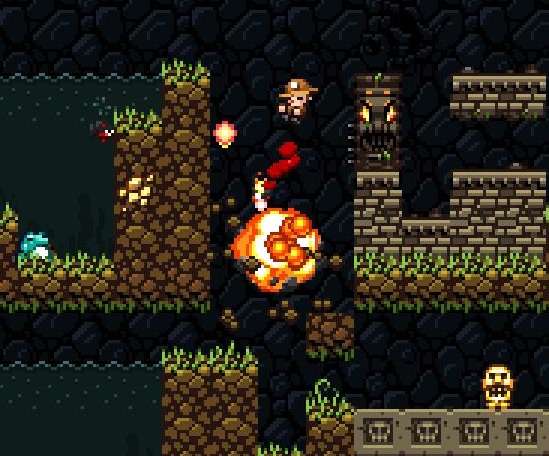
I started thinking—what would it be like to explain permadeath and infinite rebirth in another game? How about Spelunky? What’s going on there? Shall we sink into the sweaty morass of its diegesis—down into those caverns where La Mulana and Nethack collide head-on? There are bits of brain spattered all over the walls. There are little bats squeaking adorably. I am killing the shopkeeper, over and over again, throughout eternity. Yes. Let’s do this. Let’s make this as crazy as possible.

There are many archaeologists.

Under layers of dirt and grime and tattered clothing, each archaeologist seems identical, but each is really a unique man, each capable of unique mistakes and uniquely spectacular deaths. Some die in a fluke accident five seconds inside—others last longer.

Some are wicked, heartless fellows. They toss the women around like beanbags. Some are kinder. Some proceed cautiously, wringing every last ounce of gold out of the place before creeping on. Some will use the lady’s corpse to bludgeon a skeleton to death. Some will sacrifice her to Kali! But in the end, everyone wants to kill the shopkeeper—web him to the floor, blow out his brains from behind with a pistol. What can we say? It’s something about these caves.

The archaeologist is a ghost.

That’s why you keep running the same dungeon over and over, see. You ran it once, in human form—you probably died in the tutorial cave, or moments afterwards, feeling the first bat’s teeth in your jugular. Whatever it was, it wasn’t impressive.

So now you’re a ghost. Still unwilling to release its pathetic grip on your corpse, your spirit dreams endlessly of running the dungeon, of the infinite disasters you would have met had insane chance allowed you to live a minute longer—another minute—a few seconds. You run the dungeon over and over and over again, but your imagination always fails you: you have not yet imagined the dungeon’s furthest point. Someday, you might. You might dream a victory profound enough to bring this all to an end.

It will probably take you a long time.

There is no archaeologist.

We plumbed these tunnels with sonar long ago, and found them so complex and endless that it would be madness to send a team down there—and worse than madness to send a man alone and unaided. So we’ve simulated all its terrors, and now we’re taking applications. Applications for Suicidal Hero, that is.

Each applicant is tested  against the program. We’re looking for the ideal string of hops and whips and sprints and crimes. We’ll put them through again and again until we’re sure: the perfect super-soldier. We’ll train him up. It’ll be like Ender’s Game, but underground. Or something. When it all comes down to the big win, the blood will be real. The archaeologist will be carrying a machine gun, and he’ll be wearing a super-science bodysuit that gives him super-strength, and he won’t actually be an archaeologist. If he dies on the spikes, it’ll be a lot grosser than what you’re used to in 8-bit.

The archaeologist is a mistake.

We didn’t mean for you to see us. Truly, we’re very sorry. Usually when we go out into public, we make sure the holographic cloaking devices are fully powered. Nobody wants to see a tentacle-beast straight out of HP Lovecraft go waddling down the street in full daylight, and none of us wants to have to hunt down and mind-erase the blistered memories of any Earthling who saw us like that. It’s a sticky business, it is.

But you—with you, we screwed up. By the time we found you huddled in the dumpster, brain a soup, face stained with tears and twisted permanently with disgust and horror, your memories were burned too deep to wipe away. So we gave you Spelunky instead: we took you to the orbiting mothership and hooked you up to the game. It’ll give you something to do while we research a cure for Madness. It’ll provide you with infinite bliss! There’s no getting tired of Spelunky. Not as far as we know, anyway—we once had a patient on it for forty years while we tried to fix him up, and we’ll keep you on it, too, as long as we feel is necessary. It’s like a kind of therapy. It’ll soothe your splintered consciousness back into shape, so it will. You’ll play it forever, if you have to!

And you can play it forever. That game is a bitch to beat, even when you’ve got forty tentacles, like we do, and a mind capable of thinking twelve thoughts simultaneously.

Pfft. Spelunky.

Having a minor crank about games PR

There’s something that’s always bothered me about games PR and marketing: some companies turn out hype copy that’s either grammatically incorrect, soulless, or nonsensical. Stuff that reads more like a frantic commercial software pitch than an attempt to capture my imagination. It’s true for plenty of products, yeah—I mean, this is the whole point of having television commercials—but it usually only bothers me when it’s for games. See, try reading the new XCOM FPS’s press release aloud:

XCOM is the re-imagining of the classic tale of humanity’s struggle against an unknown enemy that puts players directly into the shoes of an FBI agent tasked with identifying and eliminating the growing threat. True to the roots of the franchise, players will be placed in charge of overcoming high-stake odds through risky strategic gambits coupled with heart-stopping combat experiences that pit human ingenuity – and frailty – against a foe beyond comprehension. By setting the game in a first-person perspective, players will be able to feel the tension and fear that comes with combating a faceless enemy that is violently probing and plotting its way into our world.

It’s miles better than a lot of other stuff out there, but it still fights my tongue: I feel like I want to pause for a comma, but I never get a chance. The second half tends toward evocative description, but it’s not enough to make up for OVERCOMING HIGH-STAKE ODDS THROUGH RISKY STRATEGIC GAMBITS COUPLED WITH HEART-STOPPING COMBAT EXPERIENCES et cetera et cetera.

PR people sometimes seem to think that LOTS OF WORDS WITHOUT STOPPING is better than dramatic pacing. Have they been locked to a certain number of sentences? Is there some company rule commanding that “YOU ARE LIMITED TO ZERO COMMAS,” or something like that? Maybe every PR staffer contributes one ‘exciting’ phrase to a giant bucket, and their team leader stays up until four in the morning trying to figure out how to fit them all into a hundred words? I sometimes feel like these things are written by robots or Pinocchio-boys who desperately want to understand human ecstasy: they grasp helplessly at words while we pity them for their sterile alien minds. It’s almost wistful, it is.

Passion’s the thing here—why do they dance around the original game so much? Why not reference it directly? So many wonderful things have been written about X-COM that it this marketing fluff seems even more out of place to me than it normally does: ever since I started keeping up with games journalism about five years ago, I’ve been constantly impressed by the enthusiasm great writers have for X-COM. Alec Meer wrote a powerful account of his youthful collision with the game only a few days ago, and it made me want to run out immediately, find a copy, and slobber all over it. It grates against my sense of justice, this marketing nonsense does. There should have been some genuine emotion here—I mean, if any game has really grabbed people by the hearts and the brains simultaneously, it’s X-COM. There are a bunch people out there who could have made pretty words about the new game. It shouldn’t have been hard to put together a release that’s more– more on an emotional level– than just a picture and a paragraph. If they’d done that, the response might not have been so hypercritical.

I know this is not terribly important. It’s just that XCOM is the thing this week, and for once, the Thing of the Week demonstrates a long-standing pet peeve of mine. I mean, take a look at this blurb about Assassin’s Creed from Steam:

Assassin’s Creed™ is the next-gen game developed by Ubisoft Montreal that redefines the action genre. While other games claim to be next-gen with impressive graphics and physics, Assassin’s Creed merges technology, game design, theme and emotions into a world where you instigate chaos and become a vulnerable, yet powerful, agent of change.

It sounds like the kind of thesis proposal I would churn up at two in the morning on a Sunday.

The Second Person Shooter Podcast // Episode 1: Difficult Games

2PS Podcast 1

Here’s to thoughtful discussion and awesome stories!  In our inaugural episode we talk about different types of difficult games and why we enjoy them.  Tune in for:

– Witty banter, sultry tones and a killer chiptune.

– The Mac ‘N Cheese / canned tuna metaphor, and why it doesn’t apply to Demon’s Souls

– Differing opinions on Don’t Look Back

– Killing the things we love a la Edgar Allan Poe

We will be on iTunes as soon as we’re approved — it might be a couple of days.  In the meantime, though, enjoy some embedded goodness and let us know what you think in the comments or at secondpersonshooter@gmail.com.  Don’t hesitate to send us questions, topic suggestions, or weak-kneed fan-mail.

A big thank you to J. Arthur Keenes for letting us use his excellent song.  It’s called “Colour Television”. (The full stop goes on the outside because it’s British spelling.)  Here’s a link to the song: http://8bitcollective.com/music/J.+Arthur+Keenes/Colour+Television/, and here is a link to more of his music: http://8bitcollective.com/members/J.+Arthur+Keenes/.

Magazines, Games and Trees

Magazines. I have them.

One of my favorite panels at PAX East was on “The Death of Print.”  In this panel John Davidson, the Editor of the new GamePro, raised a point that has worried for me for some time.  Print media seems to be at odds with environmentalism.  The UN says that deforestation is “now widely recognized as one of the most critical environmental problems facing the human society today with serious long term economic, social and ecological consequences.”  John shared a startling statistic: if a print magazine sells 30% of the magazines that it prints, this is considered a success.  That means that 70% of magazines are simply thrown away.

Chris Dahlen, the managing editor of Kill Screen, raised the issue of the magazine as artifact.  The problem with an article on the Internet is that you can’t hold it in your hands.  You can’t put it in a box in your attic and find it twenty years later, brushing off a cloud of dust and swelling with nostalgia.

I love books.  I love the way that they smell and the way that they feel on my thumbs and my index fingers.  I love the sound of a page turning and I love lying on a couch with a book on my chest and a lamp behind me.  Flipping through Kill Screen and GamePro on the bus to Boston was a wonderful experience – the writing was uncommonly good and I didn’t have dozens of banners and tabs distracting me.  If print died a part of me would die with it.

Which is why I struggle with this so much.  Sometimes it seems like art and the environment are at odds and I have to choose a side.

The issue is bigger than just print magazines – video games themselves are by nature unsustainable.  Computers and consoles have dangerous toxins in them that are often illegally recycled overseas, posing serious health and environmental risks.  (Read this.)  Playing games consumes lots of energy, and I’ve bought dozens of games, only rarely considering the environmental implications of my purchases.  I care about the planet, but I deeply care about games as well.  I’ve been struggling to reconcile all of this.

Other mediums like movies aren’t particularly sustainable either, but movies have been vehicles for change more often than games have.  Documentaries like An Inconvenient Truth and Exporting Harm (topical – a 2002 documentary about electronic waste in China) have been able to profoundly raise public awareness about important issues.  We haven’t had our world-shaking game yet.

A view inside the burn houses where women sit by the fireplaces and cook imported computer parts. Guiyu, China. May 2008 ©2008 Basel Action Network (BAN)

The thing is, I think that we can.  Games are an extremely young medium, and we have a lot of room to grow.  Right now, the primary concern in game design is whether or not the player is having fun.  This isn’t the case in other art forms; many movies, paintings, photographs, novels, and plays are crafted to make the viewer uncomfortable, for instance.  Don’t get me wrong, I’m all for having fun, but why can’t we have other emotional experiences as well?  Why can’t we have a mystery game where we explore a recycling factory in China?

I appreciated John Davidson’s comment because I’m glad to be reminded that other people out there struggle with these things too.  Once a year there’s an exciting festival in New York called Games for Change – it happens in a bit over a month. Unfortunately that’s right before exams, but you should go if you can.  Here at Dartmouth, the tiltfactor lab is focused on game design for social change.  In the coming weeks I’m going to play a few games that are taking risks and pushing the boundaries of what games might be able to be and write about them here.

So those are my thoughts.  I read an article today that deforestation has been on the decline in the past decade – the rate is “remains alarming,” but it’s nice to read good news once in a while.  I have to believe that there is a way for video games and magazines to exist in a healthy world.  What do all of you think about this?

My life is basically magical

I am a member of a college fraternity. Yes, I am! And I’m a girl. See, it’s a co-ed fraternity, and it’s got quite the diverse membership. We’ve got theater kids and government majors and engineers and aspiring writers and computer science folks. If there’s one thing that unites us, though, it’s a love of gaming.

Games of any kind. I’ll give you the overview.  We’ve got five or six members who play MW2 almost obsessively. We’ve got other members who play Brawl together all the time. We’ve got several Dungeons and Dragons games going on during any given term. We’ve got several hundred board and card games, including Betrayal at the House on the Hill, Apples to Apples, Bananagrams, a bunch of Avalon Hill games, Diplomacy, The Arkham Horror, Settlers of Catan—all the good stuff. We’ve got board-game addicts, and we’ve got casual players who almost never play. We’ve got Jungle Speed, and we’ve got house members who have Jungle Speed scars. One of our officers plays Hearts of Iron for what seems like several hours every day, usually while watching television. Though we’ve all got different levels of interest in gaming– a few members have almost zero interest– there’s definitely a strong pro-gaming atmosphere here. Every term we host a weekend-long games ‘convention’ called Dartcon where we sit around until four in the morning playing  Ticket to Ride and stuff like that. It’s excellent.

Anyway, I’ve become kind of an indie gaming resource—I like digging up neat indie PC games that other house members will enjoy. When I turned up in our living room with Sleep is Death this past weekend, I knew that there would be people around willing to play. And there were. It was excellent.

And because I know there’s an interest, I’ve been holding Indie Games Hours there. I’ve done two so far, and I plan to do more in the future. Generally, we meet in the house with our laptops and pass them around, running, say, Space Giraffe (didn’t go over so well), or Mount and Blade, or Torchlight, or something. I also want to do a MAME day at some point in the future—I’d zip together a pack of roms, have them all download MAMEUI, and email everyone the zip. And I want to organize a TF2 orgy, or something—it would be great fun to do our own kind of half-LAN, all sitting in the living room together, shooting each other in the face. So far, my Indie Games Hours have been classified as recruitment events– we understand that playing games together can be the best way to meet someone. You can get to know someone through game-playing almost better than any other method of socialization, except, maybe, for getting drunk with them. There are people in the house who like to do both simultaneously.

I want to learn about other real-world gaming communities. I was never really sentient during the grand age of LAN. Prior to joining this house, most of my experiences gaming with friends consisted of the Friday-night Age of Mythology matches I’d play with pals in middle school– a bit remote, and a bit isolated. But things are different now. Anyway, tell me about what you do. I don’t want to hear about your clan. I want to hear about the people you eat with, the people you live with, or go to the movies with—the friends whose faces you know. What do you guys do? How dead is the LAN? Do you play board games with the same folks you play TF2 with? Do you still play the old games you played together as kids? I once read somewhere that word of mouth is the biggest seller for AAA games, even over reviews—but what about indie games? Do you talk about them with your friends? Do you play them with your friends? Here at my fraternity, we’ve got a few members who sit down together regularly to play Realm of the Mad God! This is basically magical, to me. It’s marvelous.

What about you guys?

Games Ebert

Hello, I am a college student. When I am not reading academic articles about the transgression of gender boundaries in French autobiographical comics, I am reading about video games. Let me assure you, both are basically interesting, but it is far less fulfilling to study something which you cannot participate in yourself. So I enjoy the games writing much, much more.

It's Lacan! GET HIM AWAY

Why do I feel that I can’t participate in comics? See, I cannot draw, so I cannot make comics. And I can’t write about comics, either, since there are already academic rules about what you can and can’t say about comics. I consider this bullshit, but there you go: I’m getting graded on what I write about comics, and it isn’t fun anymore. But writing about games is awesome, since there aren’t too many rules, and I can say whatever I believe. I can play indie games and write about them and not feel like an asshole, whereas I would feel like an asshole if I wrote about edgy art comics, since they’ve been around since the seventies and everyone’s been writing Lacanian interpretations of them forever, so it’s old old news, and I’d be an idiot to pretend that I have something new to say. But everything about games is new news.

Do you understand? I feel that I understand the territory of games. I’ve got the map of games. It’s practically the only territory I understand at all. I’m a history student, but I don’t have the mastery of history that I have of games, and there are already a million giants of history scholarship to turn to for intellectual guidance. When you’ve got a giant to turn to, it necessarily prevents you from thinking in a fresh and unfettered way. If there were giants of games writing, I’d feel as crushed and worthless about games as I do about comics, or about Napoleon.

When intellectual giants have taken up residence in a medium, it’s hard to respond to the medium in a new way, unless your idea of ‘response’ is to fight with them over new paradigms of interpretation. Having a standard scholarship gives you the vocabulary and the shared experiences to communicate with other people about your medium, but it also limits you. Here’s a metaphor: forging a new way up a rock face is very exciting for some climbers, but those are the climbers who sometimes end up dead. The ones who stick to the pitons that are already in place aren’t going to be famous, and they’re not going to make the art of rock climbing any more exciting or diverse, but at least they’ll live to climb again.

(Anyway: read Thomas Kuhn. It will change your brain.)

But games are fresh. Games have no Roger Ebert to call their own: no mastermind of criticism who has eaten the medium up into himself, nobody who symbolizes Games Writing, scholarly or non-scholarly. I think that a lot of games people feel very inferior about this. See, Roger Ebert is, in some ways, a machine for doling out respect. Even people who know nothing about film and less about Ebert sense that the movies he likes are good movies, whatever that means. His praise actually affirms a movie’s status as art, and verifies its suitability as entertainment. Ebert is an arbiter of quality—he’s considered such an authoritative voice that the modern usage of ‘film critic’ has become synonymous with his name.

Games are pretty close to having their own Professor Ebert—there are some big-time, universally respected academic writers out there who are pretty close to becoming THE GUY, my favorite of whom is Ian Bogost. On the other hand, when it comes to non-academic writing, there are a bunch of famous writers, but they’re only famous among the members of our community. We don’t have a guy like Ebert.

Ebert is my straw man for this argument, but I think he makes a good one, particularly since we had that run-in with him several years ago over whether or not games are art. I think he’s sealed the tomb on himself with that comment—everyone knows he’s a dinosaur now, health problems or no. But he still embodies some solid qualities: respect, elitism, artistic value, authority. The Roger Ebert of video games would wield similar authority, if he existed. If Games Ebert—let’s call him Games Ebert—praised the artistic elements of a game, it would be accepted as a valid work of art, inside and outside the gaming community. Games Ebert would be like an ambassador to non-gamers. He’d be the one name they’d know. Games Ebert’s praise would confer significance. He would be respected as an intellectual.

Sounds tempting, right? That’s the kind of thing that most games-are-art arguments are really about: whether or not games and games-players can earn respect, and whether we can earn it by whining. Clever people have already noticed this: they’ve noticed that we all have this huge inferiority complex about our medium. If a Games Ebert descended from the sky and offered to organize our thoughts for us, there are a bunch of people out there who would jump up and slobber all over him like a pack of lost puppies.

I think this is a problem.

However, I don’t think Games Ebert going to appear anytime soon, at least in the non-academic games writing. Here’s why.

Some PAX East panels convinced me that the current games-writing atmosphere is too harsh to allow someone like Games Ebert to develop. One panel, ‘Journalists Versus Developers: The Ultimate Grudge Match,’ featured a pensive Patrick Klepek; musing about games journalism’s low pay, he addressed the talent bleed to other, more lucrative industries. In another panel, ‘The Death of Print,’ I saw Chris Dahlen from Kill Screen argue the need for long-form, mature, non-commercialized writing about games. The odds against his mission are pretty steep, as magazine sales are declining across the board and Kill Screen, though astoundingly well-written, is pretty expensive. Finally, I saw a panel called ‘Everything You Always Wanted to Know about Games Journalism…’ at which a set of very well-known panelists (Kyle Orland, Chris Grant, Lou Grossman, Susan Arendt, and Gus Mastrapa) restressed the dearth of money in that profession. They also debated the problem of review honesty and addressed concerns about the ways in which treating hype as news undermines the field.

What did I learn? First of all, there was an overwhelming consensus that games journalism is pretty difficult on an economic level. Games writers who want a family and a house sometimes feel pressured to leave the field, or to make it a secondary occupation. This prevents them from developing the maturity of experience and style which is essential to our mythical Games Ebert. Secondly, games journalism is ultra-commercialized: a lot of games writing is hyper-focused on games-as-products. Writing which addresses games on a primarily critical and artistic level has yet to find the type or number of forums which it needs in order to flourish broadly. There are people writing beautiful, non-academic prose about games, but they’re still the underdogs. Finally, games journalism’s reputation is sometimes uncertain. It can occasionally lack credibility. There are probably a million reasons for this, and a million ways to fix it, and we could argue about that forever, but it’s a fact.

Would Ebert have put all those years of thought and experience into film criticism if he couldn’t make a living off of it, or if film criticism was seen as something unintelligent, inane or stupid? I tend to think that he might have not. Ebert’s fame stems from the fact that film criticism is usually seen as a non-trivial, intellectual occupation. Games writing isn’t yet seen in the same way. I’m sure that it will be in the future, but only if games writers everywhere can invest years in the business, and only when reactionary characters like Alan Titchmarch and his idiot panelists fade out of public discourse. Will forums for intellectual writing create this atmosphere? Or does such an atmosphere have to exist before those forums will flourish? Or must other as-yet-unknown conditions be fulfilled? Must everything line up perfectly and magically, like the starry elements of some crazy celestial conjunction?

This is why I love games writing.

I have no idea—someone who knows more than I do about the history of film might be able to give a guess, but it’s always dangerous for us to make those kinds of connections between games and film. Because of that, writing this has been plenty uncomfortable for me. I want, desperately, for Games Ebert, if Games Ebert must exist, to be entirely different from Roger Ebert. I want him or her to have a gloriously unique voice and personality. I want them to wear t-shirts, not bow ties. I want them to tell jokes. They’ll need a broader, more-accepting intellectualism than Ebert’s. I guess, if I have to have a Games Ebert, I would want a messiah figure.

I understand, though, that messiah figures are dangerous. Maybe film criticism would be better off—more diverse, more creative—without a giant like Ebert? I have no idea. But I’m glad that today’s good games writers are on such equal terms, and I love that they know about each other and respond to each other’s ideas with respect. Remember the argument about Leigh Alexander’s Bayonetta article? That’s the kind of mutuality that I love about non-academic games writing today—the fact that all these people can talk to each other on a level. The kinds of things that are being said by clever people about games today are hundreds of times more interesting and valuable than anything Ebert could hope to churn out by himself. Part of it is obviously because the medium is newer, and hasn’t been wrung dry yet, but I’m sure it has something to do with this exchange of ideas, too.

See—when I think about how much I adore some of the games writing that’s taking place today, I start hoping that there will never, ever be a Roger Ebert of games, that there will never be an overbearing giant who carves up the medium and eats it alive, who makes it his own. If there was, I’d be cut off from games writing—my relationship with games writing would be like the relationship I have with comics writing, or with historical scholarship. I’d feel like a spectator. When I think about how incredible today’s games writing is, I start hoping that it can operate on unique terms. I’m convinced it can happen. It’s happening today, really.

I just—does this make sense?—I just want it to happen harder.

We’re back from PAX

…and it was absolutely exhausting. After rushing around on my feet for three days in a row, lugging a heavy sleeping bag around on my backpack and standing in lines for hours at a time, I felt like a hobo must feel after fleeing a natural disaster: dirty, tired, and psychologically destroyed by forced proximity to a vast, threatening, and uncontrollable natural force (in this case, seventy thousand gamers). Unlike a vagrant disaster survivor, however, I left with profoundly positive emotions. So. There’s that!

Kent and I spent most of the weekend attending panels and taking brief trips into the main Expo floor to play the indie games, mostly: there was the Boston Indie Showcase, as well as Joe Danger, Battleblock Theater, and, amusingly, a stand featuring some of the worst XBL Indie Games I have ever seen in my entire life (more on this later). At one point we stopped by Turbine’s Lord of the Rings Online booth to play a unique, two-person form of the game: Kent operated the keyboard and I screwed around with the mouse until we fell in a moat. A Turbine rep showed up and asked us what we were doing, and we ended up getting into a long conversation about how tough QA is. It is very tough! We attended one panel about breaking into the games industry which the speakers really ought to have titled “QA: the ass end of the games industry.” They all seemed to agree that working QA for a company which promotes from within is an excellent way for complete non-coders and non-artists to maybe possibly obtain probable and vague games industry jobs at some point in their futures, a proposition which the fresh-faced audience accepted with nervous hesitation.

It was only then that I began to feel grateful that I aspire to merely write about games. If you can’t do, you write, and if you can’t write, you… teach physical education, or something like that? I think that’s how it goes.

At any rate, we played Joe Danger, Battleblock Theater, the new Prince of Persia, and a few other games that I cannot recall at the moment, as I have misplaced my journalistic Steno pad with all my notes on it. Writeups will come in the future! We also attended a number of panels. Because we are totally obsessed with games writing, we found the ones about games writing—there were two—to be the most interesting, and we each have personal responses that we’re working on writing up. We also attended the 1UP Retronauts podcast, where we were astonished by the panelists’ apparent disposable incomes—they spoke for an hour about the crazy amounts of money they gleefully pay for terrible old games. There is apparently an appeal to this which I personally cannot understand. We also attended a panel about the history of General Computer Corporation, the company of MIT dropouts who developed Ms. Pacman and a number of Atari products: another enjoyable hour spent in the lecture theater. All in all, I think I learned more about the history of gaming in these two panels than I have ever learned in my entire life. Very fortifying for the soul and the mind, yes.

All I can say is that I hope they relocate to the larger convention center near the airport next time, as fitting seventy thousand people into Hynes was an incredibly foolish idea. Though the other convention center isn’t as convenient, it is so large that the Silver Line goes through its basement. Yes.  It contains multitudes.

Stay tuned for GAEMS JORNALIZM

Torchlight is like a job you don’t get paid for

Attention universe! I have completed the primary Torchlight campaign! Why did it take me three months of halfhearted, intermittent play? I will tell you. It is because there is no point to Torchlight.

See, unless clicking on colorful enemies is what you enjoy most in life, there’s almost no reason to ‘finish’ playing the game. Because Torchlight has an Endless Dungeon mode, finishing the primary plot only enables more and more of the same-old same-old: you get to go further down, and you get to click on baddies and receive loot. Nothing new there. There’s also no emotional or narrative reward to finishing the plot itself. Quite a lot has been said about the skeletal nature of the game’s plot, about how tepid, uncommitted, and unclear it is.  Not only does it provide no resolution—the dungeon continues—but it makes no sense. The final boss-fight is a tedious and largely-unfair low-framerate ass-raping in which the game’s evil mastermind—a badly-explained, overpowered something called ‘Ordrak’—spams mobs at you for twenty minutes. When you’re done you get a shit-ton of worthless loot.

So why did I keep at it? Frankly, I’m a sucker for numbers that go up. Preferably, numbers that go up very high, and very quickly. It’s why I bothered finishing Infectionator: World Dominator, even though I broke the game, balance-wise, while still in Africa. In Torchlight, the numbers never stop going up. It is impossible to play for an hour without leveling up twice. You are presented with improved gear so frequently that it is hard to keep track of how fast those numbers are rising. There’s not too much need for strategic assessment: each weapon has a tooltip detailing its DPS and bonuses and providing a side-by-side comparison with your current loadout. You simply look at the numbers and choose whatever has the bigger ones. At times, this kind of constant reward feels very sinister, as if the game is trying to keep you sated with numerals while it simultaneously performs a subliminal and evil reconstruction of your brain. You stagger away from the computer, a lizardlike numbness reigning in your mind, and all night long digits scroll before your eyes while the clink of gold rattles in your ears. This is Torchlight. It’s addictive like a Facebook game, but with all the garish stupidity of that genre replaced by Diablo nostalgia. It is a powerful and scientific designer drug.

But the habit is relatively easy to break. Like I said, it quickly becomes clear that there’s no higher reward to playing the game. No dramatic conclusion, no ultimate weapon, no satisfying plot twist. Just more and more of the same. This was apparently the aim of the design team, and by gum, they seem to have accomplished it. If ‘the same’ isn’t enough for you, I can’t see why you’d bother finishing the game, unless it’s for street-cred-related reasons. Instead of dragging me onward, it only left me exhausted.

This raises questions for me, though: do I play games because I want a continuing experience, or because I want a story or a progression that eventually comes to an end, the way a book or a movie does? For me, I’ve discovered that it’s the latter. I don’t want to play the same thing for ever and ever; it’s only human that our tales come to ends. If a game doesn’t want to tell me a serious story, fine, but it’s at least got to resolve itself somehow, because that, too, is human. Currently, my conception of a ‘good game’—and I understand that, with social games, casual games, DLC and so on, this isn’t the way the industry is heading—is something with a beginning, a middle, and a proper, conclusive end. A death. A max level. A final challenge that unlocks extras, maybe. Anything but an infinite perpetuation of identical play experiences. I don’t need to be able to win it—I just need to be able to feel a sense of closure, or to have a chance to find my own kind of closure. Me, personally. Any thoughts on this, guys?

Here’s a secret about me and Torchlight: I almost didn’t quit. Apparently, there’s a secret level filled with horses for characters in the 40s level range, based on the cow level in Diablo II. I consider this idea incredibly attractive. But you have to grind the incredibly dull fishing minigame to get there, so I’ve decided that I won’t be bothering.

Second Person Shooter at PAX East!

Laura and I are going to be perusing the games, panels, and booths of PAX East for the next few days.  If you’re going to be there, let us know!  Here are a few of the panels we’re excited for:

Storytelling in the World of Interactive Fiction

Text adventures have been quietly experimenting with narrative gaming for thirty years. Five authors from the amateur interactive fiction community discuss the design ideas in their games — reordered storylines, unreliable narrators, deeply responsive NPCs — and how they apply to other kinds of games.

Panelists Include: J. Robinson Wheeler [JRW Digital Media], Robb Sherwin, Aaron Reed, Emily Short, Andrew Plotkin

Indies Will Shoot You In The Knees – Why We Don’t Play Fair

Everyone is talking about Indie games — titles like World of Goo, Braid, and AaaaaAAaaaAAAaaAAAAaAAAAA!!! — A Reckless Disregard for Gravity are making press and making money. But they’re fighting against games with $200 million dollar budgets and 100+ person dev teams. How do Indies compete? Three Boston-based Indie developers will check their water-guns at the door and tell you why and how Indie games are kicking more ass, taking more names, and chewing more bubblegum than their AAA rivals. You will hear from the Ichiro Lambe (IGF Finalist Dejobaan Games, Aaaaa!), Scott Macmillan (Macguffin Games, All Heroes Die) and ex-Bungie AI wizard Damián Isla, founder of the new indie Moonshot Games. The panel will be moderated by Eitan Glinert, founder of Fire Hose Games

The Death of Print

It´s no longer a secret: Print is a dying medium. The past few years have been brutal for print media in the game space, but the plummeting sales and editorial team layoffs came to a head in 2009. It´s no surprise many of the key players at those institutions have moved on to web-based ventures, but has the industry as a whole ultimately lost something or gained something? In this 60-minute panel, Russ Pitts, Editor-in-Chief of The Escapist speaks to several journalists who were deeply involved with the events of the past year about the run-up to the decline of print, and the effects on game journalism – and games. Panelists: John Davison, Editor of the new Gamepro Jeff Green, formerly of Games for Windows Magazine, Julian Murdoch, Freelance Writer.

But Thou Must: Choice in Games

Role-playing games need choice to propel the plot and motivate the player. The methods can vary from smoke and mirrors to extreme branching reactivity – what is the right balance to strike in a game? This panel dissects SEGA and Obsidian’s Alpha Protocol, the issues involved with introducing choice into a real-world spy genre, and presenting the consequence to the player – along with the consequences it had for the development team.

Panelists Include: Joseph Bulock [Cinematics Designer, Obsidian Entertainment], Shon Stewart [Lead Cinematics Animator, Obsidian Entertainment], Matt MacLean [Lead Systems Designer, Obsidian Entertainment], Chris Avellone [Lead Designer, Obsidian Entertainment]

Forcing Your Way In & Coming Out On Top: The Game Industry in Rainbow Color

Many of the friends and writers of the GayGamer.net community are a mixture of people that work or have worked in various fields within the gaming industry from big-time producers to lowly QA grunts. We’re back again, with our east coast crew to impart our wisdom of what the industry is like for anyone trying to get a foot in the door as well as what it can be like for someone doesn’t quite fit the status quo. Flynn DeMarco, Chris Schroyer, David Edison, and Helen McWilliams will divulge how we made it into programming, production, marketing, and media, impart war stories we’ve collected from the trenches, discuss the multitude of issues that can arise in the ever expanding ecosystem that is the game industry, and show how the game industry is growing with everyone in mind and in action.

Sequelitis Snake Oil: Quack Medicine for the Video Game Industry

Why do passionate gamers treat the word “sequel” as a pejorative while often bestowing their highest praise upon those very same sequels? This panel will seek to diagnose the video game industry’s purported “sequelitis” and – by way of discussion from thoughtful panelists, including Irrational Games’ Ken Levine; Harmonix’s Dan Teasdale; Giant Bomb’s Jeff Gerstmann; and moderator Chris Grant, from Joystiq – debunk the quack medicine that’s identified video game sequels to be symptomatic of the industry’s creative bankruptcy.

Sounds fun, right?  You can find the full list of panels here.

We will also get a chance to check out the games in the Boston Indie Showcase that PAX selected for the event:

Miegakure (Marc ten Bosch)
AaaaaAAaaa…A Reckless Disregard for Gravity (Dejobaan)
Dearth (MIT Gambit Game Lab)
Waker (MIT Gambit Game Lab)
Turba (Keith Morgado)
Slam Bolt Scrappers (Fire Hose Games)

If there’s anything you’re particularly interested in hearing about, don’t hesitate to leave a comment or drop us an email.  Watch this space for the next week or so for thoughtful coverage of the event.  Hope to see you there!

Max Payne and the Pictoralists

Kent’s post about games and their relation to old media got me thinking. It’s best to read this one if you’ve read his first.

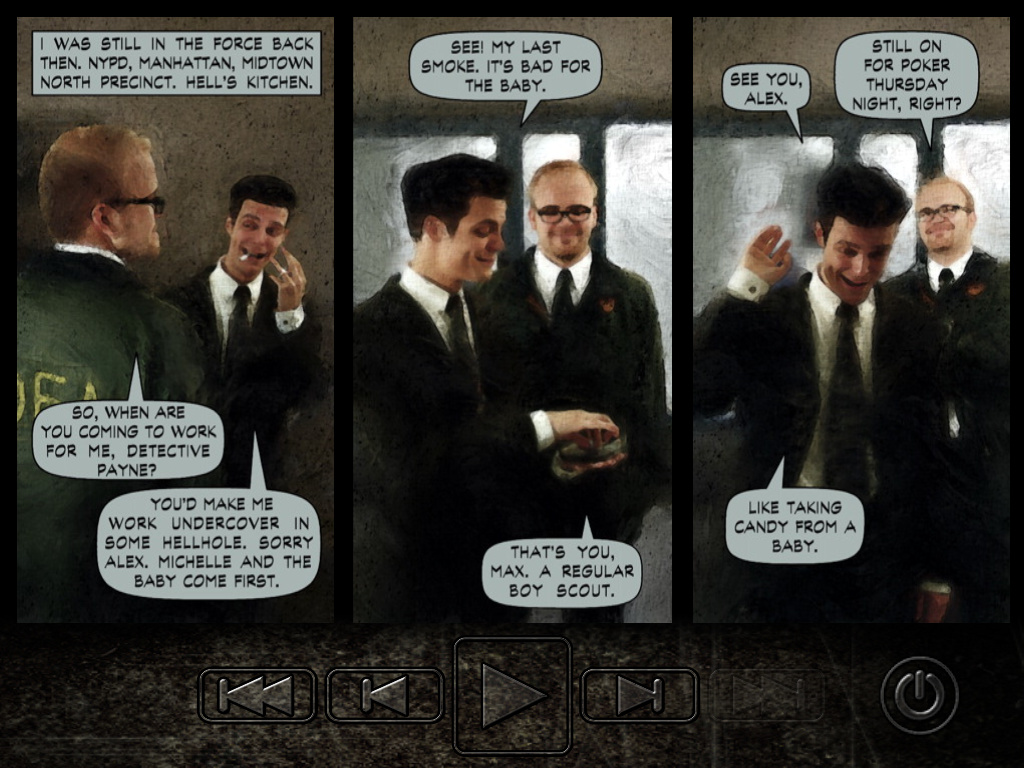
Because my 360 is at school and my computer is too shoddy to handle Bioshock 2 right now, I’m currently playing Max Payne. In case you never played Max Payne, here’s what you need to know: it is The Departed crossed with John Woo crossed with every B-movie cops-and-robbers flick you’ve ever seen. All the cutscenes are comic strips. They’re not even real comics: they’re photographs layered over with ultra-cheesy Photoshop art filters, with speech bubbles and word boxes slapped on top. The language is such a heavy kind of noirish nonsense that it gets hard to handle after a while. Constant references to the dark nature of the city, the predatory howl of sirens, the call of the night, that kind of thing. In short, the game wants so badly to be everything that crime novels, action movies, and gritty thriller comics have ever been that it’s practically bleeding out the anus to accomplish this.

Nevertheless, it’s fun as hell. The John Woo fighting moves are incorporated as bullet-time dodge-jump-and-shoot attacks—at one point, Max even remarks that he’s about to get “all Chow Yun Fat” on his enemies’ collective rear ends. It’s marvelous. The whole game crawls right up into that sweaty place under the armpit of twentieth-century pulp fiction and sits there grinning like a monkey and clapping its hands, and there’s nothing you can do but love it.

Aside from the bullet time effects, which were very unique and awesome when the game came out, there’s not much special about the stuff the player does in the game. You’ve got a million different weapons, grenades, rocket launchers, et cetera. Stupid boss fights. A couple halfhearted puzzles, because every game in the universe needs a puzzle, right? It’s the standard shooter rigmarole through and through. A few hallway laser-bomb puzzles are direct references to situations found in Half-Life. What saves it from being derivative is the style: By accessing that whole antihero-thriller- noir-cops-and-robbers heritage, Max Payne transformed itself from a poorly-balanced shooter into something completely magical.

Its aims are a bit like those of the Pictoralists, described in Kent’s post, but with a bit more punch. Max Payne adopted non-gamic inspiration in the most audacious manner possible by flaunting its relationship to movies and comics. It’s trying to be a movie and a comic, at the same time, while also being a game. The basic attacks are obvious homages to Woo’s Hard Boiled, for crying out loud! It doesn’t try to be a movie in the same way that Heavy Rain does, but it’s still trying, and it cleaves so tightly to that heritage that it inherits all the excitement and energy of the old media. It knows why we love movies and trashy books and comics, and plays up to that. We don’t keep playing Max Payne simply because the game itself is well-made; we love it because it’s a bombastic send-up of everything pulp and horrible. In spirit and attitude, it’s the ultimate action movie and the ultimate comic.

So: Demons’ Souls is fantastic, on a gamic level. But not every game has to be Demons’ Souls. And not every game should be. Games that go in the exact opposite direction are often just as marvelous.